

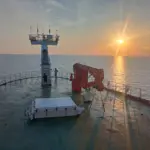




Maxsea offers new oceanic identification system in 3D
Technology described by experts as the most significant breakthrough in fishing in recent years has just been upgraded to offer even more information, and to make it easier still for fishermen to make practical use of it.
Fishermen hunting pelagic fish such as tuna, mackerel, or anchovy are constantly trying to minimize the cost of their operations. With its well established 3D capabilities MaxSea is already known as one of the most innovative PC based plotter programs available to the fishing industry. In addition, MaxSea now provides tools that help identify oceanic conditions preferred by certain species of fish. There are specific software packages for long-liners, tuna fishing, deep sea trawlers, and others.
Fishing Buoys tracked on Electronic Charts
In various fisheries buoys report their position and other data back to the vessel. Some fishing buoys report via satellite, and others, such as the Australian LINEMASTER buoys communicate their own GPS position and other data directly and automatically to the vessel via radio.
MaxSea can now display the positions of widely used SERPE, RYOKUSEI, and LINEMASTER buoys directly on the chart. MaxSea and Serpe Buoys are commonly used by purse seiners worldwide. Serpe has now released a new model of Inmarsat D+ buoys that encounter a real success on the market. For more details, refer to www.serpe-iesm.com
Longliners prefer to use the LINEMASTER beacons, very popular in Australia, New Zealand and now more and more in all the Pacific.
For more details, refer to www.linemaster.au.com
MaxSea fishing software has just launched a new package called “MaxSea Longline” and has started to equip the Australian and Kiwi longline fleet, targeting now at the whole Indian Ocean.
This new package allows to track fishing buoys on detailed charts, to display their track in a colour that changes with the temperature, allowing at a quick glance to see if these buoys are in thermocline areas or not.
The program tracks their movement over time, similarly to the way the fishing vessel’s own track is recorded. Each track point stores the date, time, position, drift rate and temperature of the buoy. A vector shows the direction to which the buoy is heading.
Different colours can be allocated to aid identification of each buoy tracked.
The temperature is clearly displayed at the latest position of the beacons.
Free Worldwide Oceanic Data via e-mail
MaxSea also offer a more advanced package that uses e-mail to provide regular meteorological and oceanic data. NavCenter’s weather forecast data is available for the entire world, giving fishermen weather predictions at six-hour intervals for three to five days ahead. The data is updated daily, and includes wind, waves and Sea Surface temperature information.
The e-mailed data can also include Sea Surface Altimetry data, which is derived from very precise satellite based measurements of the actual sea surface height. Warmer areas of sea are less dense and therefore (after correction for atmospheric pressure effects), tend to be higher than cooler areas. Altimetric maps received on board via e-mail can be displayed by MaxSea in colours representing temperature differences. These are simply overlaid on the navigation chart, on which MaxSea may also be recording tracks, local temperatures, etc., all helping to maximize the opportunity for productive fishing.
Fishing grounds in 3D
For bottom fishing, the latest Version 9 of MaxSea Fishing Software lets the fisherman view the ocean floor in a clearer, more realistic manner. Depth contours can be represented in 2D, with selected depth and bottom information, or in 3D which reveals the seafloor in a completely new way. MaxSea allows fishermen to view the sea bottom as fish see it, and as their gear experiences it, in real time 3D.
The 2D and 3D views are based on bathymetric charts, plus private depth data built up by fishermen using MaxSea’s PBG (Personal Bathy Generator). The latest version of MaxSea provides faster and more efficient ways to manage personal depth data. The data can now be compressed at high speed using the vessel’s onboard computer, thus requiring less data storage space. The latest version also allows specific categories of data to be displayed, modified, or deleted. Fishing company’s are able to exchange and merge data collected by different vessels, and to analyse fleet statistics.
Despite such sophistication, the system is relatively simple to operate. The software also interfaces with other MaxSea products, enabling, for example sounder profiles, radar overlay and ARPA target acquisition and weather data to be linked via the same computer system.
MaxSea Fishing Pro represents the most fully featured fishing software available. It and other MaxSea software products are sold and serviced world-wide by an active network of distributors based in over 20 countries on five continents. MaxSea has already established itself as the system of choice of in a number of fleets. It is available in eleven languages, including Thaï, and a Chinese version is expected to be available soon.
Related Articles
 FISHERIES
 FISHERIES
 WORLD FISHING EVENTS