




Making Indonesia’s fleet visible
At last week’s United Nation’s Ocean Conference, the Republic of Indonesia becomes the first nation ever to publish Vessel Monitoring System (VMS) data revealing the location and activity of its commercial fishing fleet.
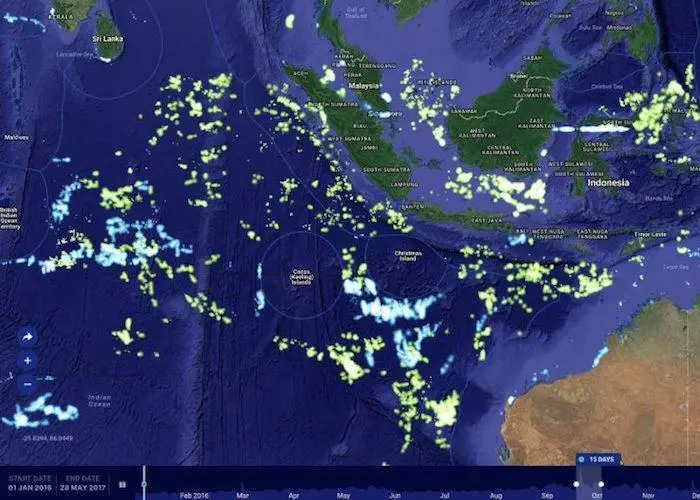
The new data being made public on the Global Fishing Watch public mapping platform reveals commercial fishing in Indonesian waters and areas of the Indian Ocean where it had previously been invisible to the public and other nations.
“Illegal fishing is an international problem, and countering it requires cross border cooperation between countries,” said Susi Pudjiastuti, the Minister of Fisheries and Marine Affairs for the Republic of Indonesia.
“I urge all nations to join me in sharing their vessel monitoring data with Global Fishing Watch. Together, we can begin a new era in transparency to end illegal and unreported fishing.”
Global Fishing Watch has committed to host any country’s VMS data, calling on other governments to follow Indonesia’s lead.
“We believe publicly shared VMS will become a powerful new standard for transparent operation in commercial fishing,” said Paul Woods, Global Fishing Watch CEO and Chief Technology Officer for SkyTruth, a founding partner of Global Fishing Watch along with Oceana and Google. “SkyTruth has been collaborating with the Indonesian government for the past two years to really understand their VMS data and find new ways for VMS to enhance their fisheries management.”
Peru becomes the first nation to follow Indonesia’s lead. Vice Minister for Fisheries and Aquaculture, Hector Soldi, announced Peru’s intent to publicly share their VMS data in Global Fishing Watch.
Global Fishing Watch uses publicly broadcast Automatic Identification System (AIS) signals from ships at sea to reveal the activity of the majority of all industrial-sized commercial fishing vessels (those exceeding a capacity of 100gt/24m). The inclusion of government-owned VMS data adds detailed information on smaller commercial fishing vessels that are not required to carry AIS, and are therefore not reliably trackable by any other means. Indonesian regulations require VMS on fishing vessels with a capacity equal to or exceeding 30gt.
Indonesia is the second-largest producer of wild-caught seafood in the world, and Indonesian VMS alone adds nearly 5000 fishing vessels to Global Fishing Watch’s existing database of 60,000 vessels.
“It’s remarkable to see how adding in all these medium sized vessels with VMS really fills in the picture for large chunks of the ocean where we knew there was fishing, but just couldn’t see it with AIS alone,” said Paul Woods. “It is also revealing new areas where we weren’t aware fishing occurs.”
Related Articles
 FISHERIES
 FISHERIES
 WORLD FISHING EVENTS