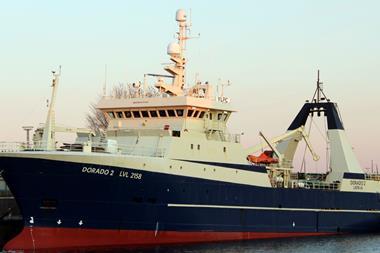





Norway’s Aas Mek Verksted has delivered the live fish carrier M/V Ronja Pioneer to Sølvtrans AS of Ålesund on the west coast of Norway, and says this is the sixth such vessel it has built for Sølvtrans.
Plant and structure
The vessel has a refrigerated seawater cooling system, oxygen and recirculation system for transporting the fish in a closed system which is able to cool the fish down ready for processing in the gutting plant. There is a cleaning and aeration plant, plus oxygen production for transported fish, a foam and ozone disinfection plant and sorting plant. There is a fish counting plant as well as a system to monitor and regulate the water quality in the cargo hold. This system is designed to prevent contamination by water from one area to any another. This complies with the Scottish authorities’ stringent regulations on transport and environmental impact conditions.
This vessel also sees the introduction of a sheltered deck for the first time to reduce dependency on good weather conditions, as well as increase safety for the crew at sea and provide more room to mount special equipment on deck.
The aeration and degasification
of recirculated water in the hold is based
on a new system with skimmer/aeration functions. Derivative foam decomposes into liquid and is collected and disinfected by heat treatment before being returned to the sea. This is a self-regulating process that makes it possible to transport fish in a closed system over longer distance and time.
The 1000 m3 hold is divided into two sections. There is a powered system for loading and unloading the vessel and a sliding bulkhead for the hold to force the fish without lowering the water level.
Services
Crew accommodation for six in four single and double cabins, all with shower and WC. A well equipped galley and mess with open fireplace and furniture of high quality, a wardrobe, laundry, sauna, and coffee bar. The wheelhouse has three operator positions for manoeuvres, remote control system for operation and monitoring of all systems and and the cranes. The main deck has provision for a laboratory for the crew, veterinarian and researcher to monitor water quality and the condition of the fish during transport.
Cargo handling
The pressure system is connected to a fish counting system, a twin vacuum pump setup with 2x5000 litre capacity tanks with sorting and counting systems and oxygen level and water quality monitors. There is an ozone system to disinfect the fish tank and pipe system. The fish tank is connected to a refrigerated seawater system with a capacity of 900.000 kcal/t to cool the seawater and the fish down to –1.5 Celsius. All systems and machinery can be monitored and remotely controlled from the bridge. The vessel also has lighting for operation of an underwater video camera to monitor the fish condition in the holding tank. The holding room is linked to a remote-controlled, jet water washing system for cleaning and disinfection.
Deck equipment
A 32 tonne Palfinger hydraulic crane, a 23t /m Palfinger crane (aft on poop deck) and a Palfinger PK8000 crane. There is a sorting plant to handle three different sizes of catch.
Propulsion
A Cat 3512 TA series B, 1350 bkW v/1600 rpm, connected to a Finnøy gear and propeller system.
Auxiliary engine – 2 x Cat C 18 TA,
each with a capacity of 515 ekW, and a Scania Marine harbour generator with capacity of 190 kW. Propeller fore and aft, each at 300 kW .