



Labels to provide traceability assurance
Norway, the world’s leading seafood supplier providing 30 million fish and shellfish meals around the globe each day, is on the verge of adopting a common standard of labelling throughout its entire fisheries industry.
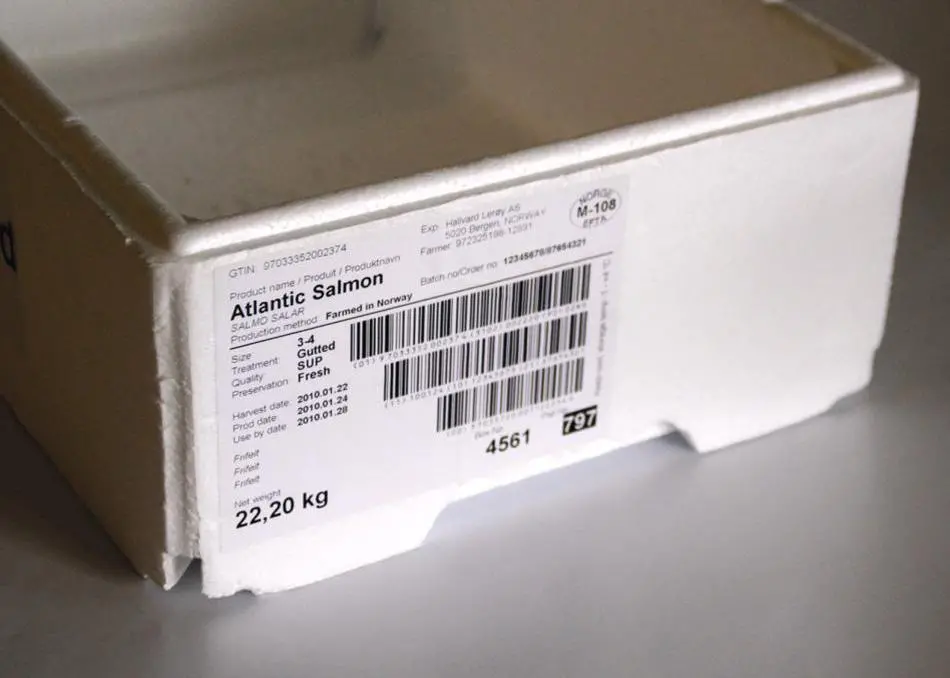
A barcoded label will be fixed to a fish crate and will follow the product from the sea or fish farm to the eventual consumer.
Information carried by the barcode will be able to be read at each stage in the distribution chain. “There is one code which will provide fast traceability and show that the product is safe and healthy,” says Øyvind André Haram, head of information at the Norwegian Seafood Federation.
The standard defines the minimum size of the label and prescribes the information to be printed on it, of which core data will be contained in the barcode. “Each fish crate will have its own unique identification,” says a spokesman from Innovation Norway, which funded the project to develop the standard. “When fish crates are loaded on to pallets, the pallets will get a label identifying which crates are on the pallet.”
Pilot project
A pilot project has successfully been carried out and it is hoped that the new standard will be approved for use by the third quarter of this year, and that all sectors of the Norwegian industry will adopt it. Certainly the signs are encouraging.
“We deal with 60 different labels,’ says Alf-Helge Aarskog, CEO of Marine Harvest, the world’s largest producer of farmed salmon, “and it would be good to get these reduced to just one. It is important that the industry starts using it [the new standard].”
On 1 January 1 2010, it became a legal requirement that fresh seafood in Norway should be labelled with the catch or harvest date. It became clear that the label on fish distribution units should be uniform and easy to understand by distributors and retailers.
Representatives of all sectors in the supply chain therefore met in April 2010 to discuss adopting a common standard of labelling and so the project, which also has the backing of the fisheries ministry and food and health authorities, was born.
Although the standard will only apply in Norway, the aim is for it to become adopted internationally. “Eventually we want consumers to demand it,” Øyvind André Haram says, “money talks.”
USA label
Meanwhile on the east coast of the USA, Agar Supply, New England’s largest independent food distributor, has joined forces with Legal Sea Foods, the Boston-based seafood restaurant group, to launch a new label which will enable restaurants and supermarkets to track fresh fish all along the supply chain.
Legal Sea Foods’ wholesale division, Nor’Easter, will supply nearly all the fresh fish marketed under Agar’s Nautifish brand.
Nor’Easter is creating a barcode label detailing when the fish was caught, the name of the vessel and its captain, the region where the fish was caught and when it was prepared for packaging.
“Seafood can sometimes be an underhanded business and we have a commitment to truth in marketing,” Karen S Bressler, chief executive of Agar Supply, told The Boston Globe newspaper. “We want to let restaurants know exactly what they’re buying as consumers demand more information.”
Related Articles
 PROCESSING & REFRIGERATION
 SEAFOOD
 SEAFOOD