




Innovation and automation key to processing farmed fish
As the seafood industry is having to increasingly rely on aquaculture for its raw material, so processing equipment suppliers are manufacturing more machines specifically for dealing with farmed fish.
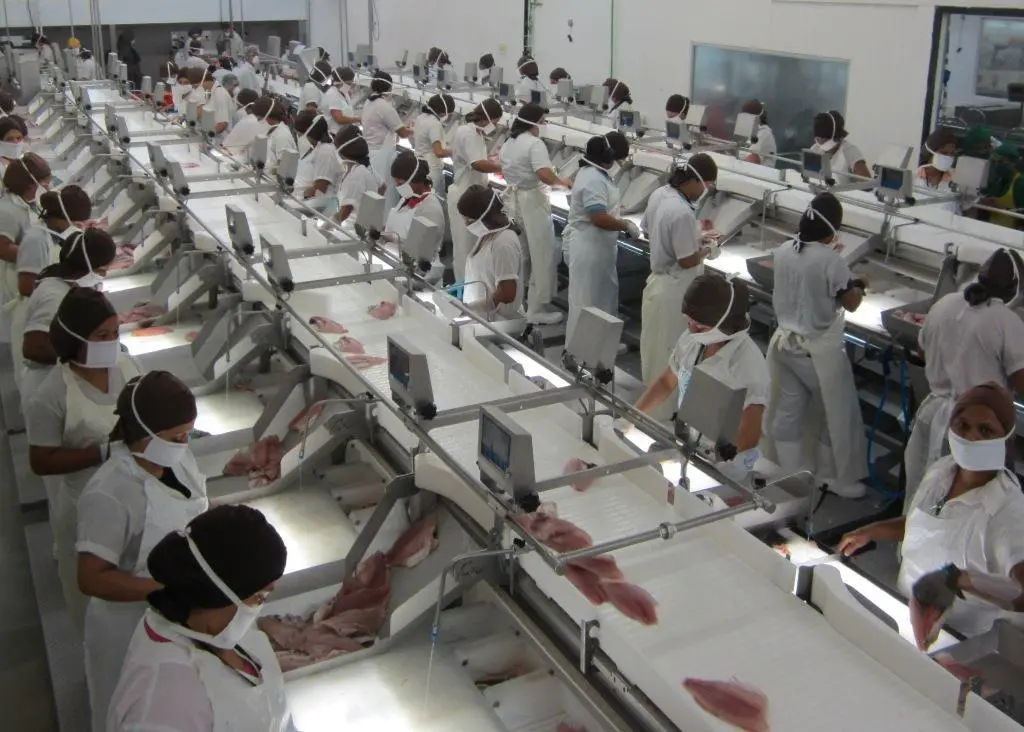
Complete lines have now been developed for processing salmon, for example, where whole fish enter the line at one end and fixed weight portions ready packed for a supermarket shelf leave at the other.
To illustrate the innovation involved, Marel, the world’s biggest fish processing equipment manufacturer, has developed a salmon portioning and robot loading system in partnership with Norwegian processor Nordlaks. Installed in that company’s factory in Stokmarknes, this system automates the process of portioning and loading fixed weight salmon portions into retail packs.
It enables what Marel describes as a seamless flow of salmon portions without manual handling. “A robot places the fish pieces directly into the packaging and the system reduces labour costs by up to 20% compared to manual operations,” says Stella Björg Kristinsdóttir, marketing manager – fish industry. The system won second prize inthe 2013 Aqua-Nor Innovation Awards.
While salmon processing systems are becoming increasingly sophisticated, salmon is just one of the farmed fish species the major processing equipment manufacturers such as Marel and Baader are dealing with. They are also developing equipment for processing farmed fish such as sea bass and sea bream, and the ‘whitefish’ species tilapia and pangasius.
In fact, these latter species, which require little or no fish protein in their diet, are likely to become more important in the future as farmed fish feeds come under increasing scrutiny for their use of wild fish.
Tilapia
In 2012, Marel installed a purpose-built tilapia processing line for Costa Rican processor Terrapez. (Terrapez is a member of the the AquaCorporación Internacional Group (Grupo ACI), which sells tilapia into the USA and Europe under the Rain Forest Aquaculture label.)
The main aims were to: speed up processing, gain better management control, increase yield and improve product handling. “We invest in areas that we believe are important and bring our products more value,” says Victor Jiménez, general manager of Grupo ACI.
The line, which is powered by Marel’s Innova software, consists of a raw material grader, filleting and trimming lines, a packing grader, various scales and data terminals, conveyors and chilling tanks. It was designed to process a minimum of 20,000 tonnes of fish annually for the Canas-based company.
Marel is devoting more effort to selling equipment in central America and even in China where processing fish has traditionally been done by hand and huge factories employ literally thousands of workers. Two years ago the company signed a contract with Pacific Andes to design, build and install a new processing system at its new factory in Qingdao.
A Marel flowline specifically designed for the high volume processing of pangasius and tilapia, as well as wild caught species such as Alaska pollock, was installed. “It represents the first stage in a drive for full automation in China’s largest whitefish production plant,” said a Marel spokesman.
With China moving to automate its fish processsing operations, then this is very significant step in reducing manual labour in the fish procesing industry as a whole.
Related Articles
 PROCESSING & REFRIGERATION
 SEAFOOD
 SEAFOOD