



Iconic Indian freshwater fish, the humpback mahseer, is on the brink of extinction according to scientists from Bournemouth University in the UK and St Albert’s College in Kochi, India.
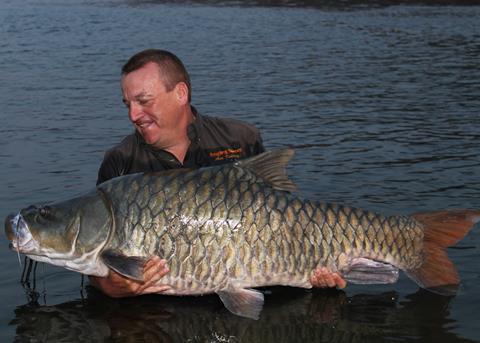
This giant member of the carp family has a distribution which has always been limited to South India’s River Cauvery basin and it’s now believed to be so endangered it may be extinct in the wild within a generation.
Adrian Pinder of Bournemouth University, said: “The blue-finned mahseer, is not native to the River Cauvery, yet our studies over the last two years have shown that they are now one of the most abundant fish in the river. Without a doubt, their success has been at the expense of the humpbacked mahseer that historically occurred throughout the entire river catchment.”
Mr Pinder has been studying the ecology of 17 species of mahseer that populate rivers throughout South-east Asia with Dr Rajeev Raghavan of St Albert’s College in India since 2010. Four of these species are already listed as ‘Endangered’ on the International Union for Conservation of Nature (IUCN) Red List.
Their recent paper co-authored with Dr Robert Britton, published by the research journal, Endangered Species Research, reveals that as well as the competition with the blue-finned mahseer, many other pressures are placed upon the fish of India’s rivers, including pollution and poaching.
In 2012, the scientists set up the Mahseer Trust, an NGO working to protect mahseer and its habitats.
They are currently focusing on sourcing specimens of the fish to obtain DNA, get the species properly identified and have it classified as ‘Critically endangered’ on the IUCN Red List.