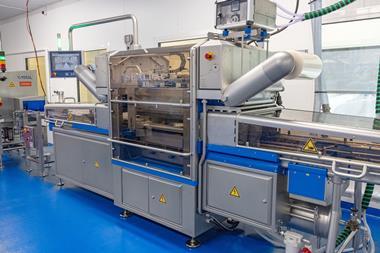




Icelandic company Valka ehf has designed a new X-ray guided water jet cutting machine for trimming and portioning fish fillets.
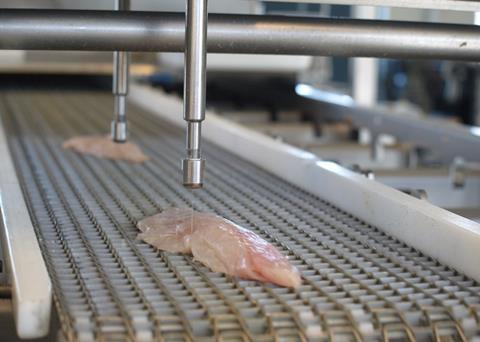
The prototype machine, which has been in development for some time in collaboration with Icelandic processor HB Grandi hf, was recently formally tested for both accuracy and throughput under the supervision of Syni Laboratory Service. The results indicate substantially less cut-off from the fillets and a great increase in the throughput.
High accuracy
With the combination of X-ray and 3D image processing, together with robot controlled water jets, this new machine can locate and cut out pinbones and portions with exceptionally high accuracy.
The machine is intended for removal of pinbones in redfish fillets.
The testing was mainly focused on three topics. Firstly, the cutting accuracy, i.e. the fillet yield after cut-off; secondly, the counting of the remaining bones; and finally the machine throughput.
Two fillet sizes were processed during the test runs, which totalled more than 500 fillets. To sum up, Valka says the testing results were very good. The yield in the test was about twice as good as with manual cutting and a total of 94% of the fillets were totally bone free. The number of bones in the total amount of the cut fish was only about 0.6 bones per kilogram, which is well within most packing requirements. A second X-ray machine can then be placed behind the line to ensure that all fillets produced on the line are completely bone free.
Evident efficiency
According to these results, Valka says it can be assumed that the loss in cut-off is half of what can be expected when the fillets are cut manually. Furthermore, there will only be about three-to-four people working on the new line instead of 10-12 who would be needed to obtain the same throughput with manual cutting. The value of bone free products is substantially greater than of bone-in products and thus the machine efficiency is evident.
At the time of writing, Valka was due to deliver the first machine built as a component into a complete processing line at HB Grandi’s facilities in Iceland in June. Further testing of the machine for different species such as pollock, cod and salmon will be continued.