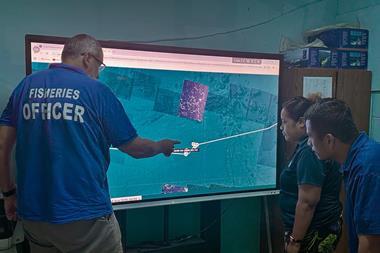



The government of the Maldives and the International Pole & Line Foundation (IPNLF) brought more than 50 fisheries officials and experts to the Maldives to discuss the management of the Indian Ocean’s tuna stocks and to align on an agreed proposal for the implementation of robust harvest control rules (HCR) in the region.
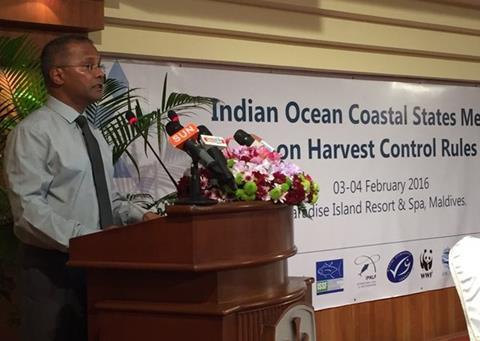
The Indian Ocean Coastal States Workshop, held on 3-4 February, was also attended by WWF, the Marine Stewardship Council and the International Seafood Sustainability Foundation, as well as three IPNLF Members – Sainsbury’s, Marks & Spencer and World Wise Foods. All were on hand to provide additional support and co-sponsorship.
The workshop’s overarching objective was to ensure that the shared tuna resources - which are critical to economies, communities, and cultures throughout the Indian Ocean - can continue to provide jobs, food, and development opportunities for many generations to come.
In his opening address Dr Mohamed Shainee, Minister of Fisheries and Agriculture for the Maldives, emphasised the importance of having a harvest strategy formally adopted by the IOTC.
“We need to explicitly agree an approach to deal with situations should stock levels breach those reference points – that is why we are here,” said Dr Shainee.
The official body tasked to manage this critically important natural resource is the Indian Ocean Tuna Commission (IOTC), which comprises 32 member countries involved in fisheries in the region. Eighteen of the 20 developing coastal states that are full members of the IOTC participated in the workshop.
In his introductory speech, IPNLF’s director for science and the Maldives, Dr Shiham Adam, who is also chair of the IOTC’s Working Party on Tropical Tuna and vice chair of the IOTCs Scientific Committee, stressed it was vitally important that the coastal states fully understood the concepts and terms used in the management procedures.
“This knowledge is crucial to ensuring scientifically-based, robust harvest control rules are in place that can buffer against uncertainty and risk,” said Dr Adam.
It is recognised that the Indian Ocean’s coastal and small island developing states all have a collective responsibility to ensure the effective management of shared tuna stocks.
In the Maldives alone, the tuna sector provides the only means of employment and livelihood for more than 20,000 fishermen and their families, while the fish provides the primary source of protein to a large proportion of the country’s population – an average of 165kg of tuna are consumed per person per year.
Attendees at the workshop produced a draft proposal on a harvest strategy for skipjack tuna, which outlines how managers will respond should the stock fall below desired levels. Participants were confident that an appropriate HCR would allow all those with fishing interests in the IOTC to maximise their benefits from the skipjack tuna fisheries in a sustainable way.
The Maldives will officially submit the proposal to the 20th Session of the IOTC, being held in La Réunion in May, by which time it expects the resolution to have the full endorsement of many other countries in the Indian Ocean.