




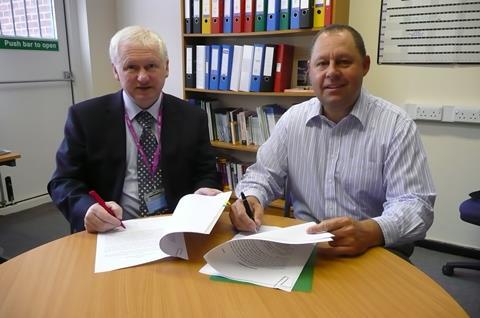
Air Products, a global supplier of food freezing and chilling systems, has joined forces with the Grimsby Institute and university students from southern China on an international research project to investigate practices for freezing, chilling and cryogenic freezing.
The research will provide a strategic review of the principles and practices of chilling and freezing food to establish best practice guidelines. It will be of great benefit to the seafood industry. “Seafood is key to us,” says Mike Dillon, vice-principal of research and expertise at Grimsby Institute, “but it is principles we will review first.”
The research will be led from the Grimsby Institute’s Food Refrigeration Process Engineering Research Centre (FRPERC) and will be carried out by research fellows Stephen James, Christian James and Graham Purnell. They will be supported by a group of research students from Guangzhou University who will be completing MSc degrees in productivity and innovation.
The students will be sponsored by Air Products which will also be providing access to cryogenic freezing systems as well as advising on how to optimise systems during the research activity.
As well as considering the potential of cryogenic freezing technologies, the research project aims to explore the role of electromagnets in advanced freezing applications. In particular, the Cells Alive System, an award-winning electromagnetic freezing system from Japan will be investigated.
Professor Dillon, who helped to bring FRPERC to Grimsby, stated: “It is great to see the applied research unit get this agreement so soon after setting up base in Grimsby.
“I know this project will be the first of many to help build our reputation nationally and internationally as a centre of excellence in the freezing and chilling of seafood.”
Jon Trembley, technology manager for cryogenic applications at Air Products, said: “This is an exciting research project that will establish guidelines that can be followed by food processors around the world at the same time as helping to realise the potential of emerging technologies in the area of food freezing and chilling.”
The organisation which became FRPERC started out in 1967 when it carried out research into meat refrigeration and processing at the then new Meat Research Institute (MRI) near Bristol.
During the next 42 years that programme was extended to cover the refrigeration, thermal processing and handling of all foods. This included chilling, freezing, thawing, tempering, refrigerated storage, refrigerated transport, refrigerated retail display, domestic handling and refrigerated storage, cooking, pasteurisation, reheating (microwave and conventional), decontamination, hygienic processing, robotic handling, automated handling and cutting.
For the last 18 years this work was carried out under the auspices of FRPERC, which was founded by current director Stephen James as part of the University of Bristol. It was closed down in 2009 but was then re-established as part of the Grimsby Institute.
Stephen James, Christian James and Graham Purnell stayed with FRPERC, while other colleagues moved elsewhere or retired.
Air Products, which was founded in 1940, provides a portfolio of atmospheric gases, process and specialty gases, performance materials, and equipment and services to customers in industrial, energy, technology and healthcare markets worldwide. In 2010, the company had revenues of $9 billion, operations in more than 40 countries, and 18,300 employees around the globe.