



Based at the heart of Boulogne’s Capécure seafood district, freight forwarder Geofret was set up in 2013 by Grégory Grare to specialise in transporting seafood as efficiently as possible.
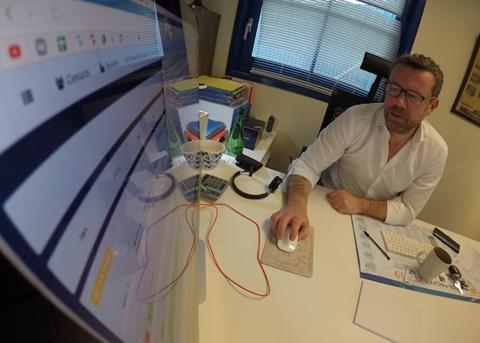
The company has a staff of four who keep everything running smoothly as they handle shipments of seafood both inside France and across Europe.
“We work in Norway, Sweden, the UK, Ireland, Belgium, Holland, Italy, Spain and Portugal,” he said. “So most of our activity is in the western part of Europe.”
Somewhere between 70 and 80% of Geofret’s business is shipping frozen seafood and the remainder is the high pressure world of shipping fresh fish.
“If frozen seafood is delayed by an hour, then the customer could have a problem, but it’s not a problem as far as the product is concerned. It’s different with fresh seafood, and that has to be organised with great care,” he said.
“We’re sending fresh sea bass and other products to Ireland from Boulogne-sur-Mer three times a week. That has to be fast and efficient, and there’s no room for errors.”
He commented that shipments can range from samples on a pallet to a complete truckload, and matching the transport to the load is high on the priority list. This is also where Geofret’s own software comes into play, selecting the best options and keeping everyone along the supply chain informed at the same time as maintaining fluidity as each shipment heads for its destination.
The fact is that if there is a problem, then human error is often the cause as something has been overlooked or information has been wrongly entered.
“That can hold things up, and the customer won’t be happy,” he said, explaining that this is something that the Geofret software not only flags up as needing attention, but also demands that the user addresses.
“If there’s a problem, it identifies it in such a way that we have to resolve the issue, and not simply overlook it until next time. This is about not just firefighting when you’re busy, but making sure the problem doesn’t recur.”
The company’s systems are being developed further, and the intention is to develop a customer dashboard, showing not only the location and status of each shipment, but also its CO2 footprint.
“Let’s say we want to send a shipment from Paris to Athens,” he said, punching the two end points into the system as a list of options instantly appeared.
“The algorithm weights good co-operation as the top parameter. We like to keep everyone happy.”
As well as matching the vehicle to the load, an important parameter is also the proximity of the vehicle to the pickup point.
“We prefer to avoid unnecessary kilometres and want to keep the missions down,” he said.
As part of its environmental engagement, Geofret has a three-year commitment with the EVE label for freight forwarders to reduce environmental impacts, and as part of the Industrie du Futur initiative which has a similar set of commitments, an external consultant takes a close look at the way the company operates.
It’s not a daunting prospect, according to Grégory Grare, who looks forward to finding out what an outsider’s viewpoint will show up.
“A fresh pair of eyes is good. Someone new will see the things that we don’t,” he said.