




A research group from Monash University Malaysia has sequences the genome of a Malaysian fish, the Asian arowana.
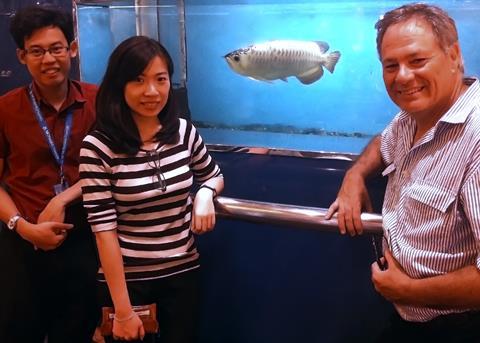
This is the first Malaysian fish genome to be sequenced and the first achieved by a Malaysian university.
Professor Christopher M. Austin, genomics cluster leader at the School of Science, said: “The arowana belongs to a very old group of fish which you could refer to as ‘living fossils.’”
“One of the things we’re interested in is: Where does it fit in the family tree of fishes? Our study actually contradicts some views on the fish family tree.”
The Asian arowana is a high-profile Southeast-Asian freshwater fish that’s highly coveted within the Chinese community as an ornamental species for its brilliant gold and red scales, a symbol of prosperity.
Its relationship to other fish species is determined by comparing a large number of genes recovered from its genome sequences to the same genes from other fish species that have also had their genomes sequenced.
Professor Austin, added: “Every species carries its genealogical history in its DNA. Using genetic sequencing and bioinformatics methods, we can actually reconstruct the path of the evolution with considerable accuracy.”
“Every new genome that’s published, therefore, helps all kinds of other genetic and genomic studies. The arowana genome is not just a genetic resource for us. It’s also a resource for anybody studying comparative biology of fish.”
The study’s results suggested that arowana is the most primitive of the modern fishes, according to Professor Austin.
He said: “The evolutionary position of the arowana has been disputed in scientific literature—whether it’s the arowana group or the eel group that’s the most primitive form. Some recent publications suggested eels, but our publication suggests the arowana, which agrees with the more traditional scientific studies.”
The appearance of the fish had not changed very much over the period of time and he warned that the fish is not an all-round primitive fish. The fact that it produces a small number of big eggs and that the males take care of the eggs is more modern.
Monash University’s research will be an important platform for future research collaboration with commercial farmers, conservationists, and other researchers interested in the Malaysian fish species.
The published arowana genome is now public and can be found online at GenBank.