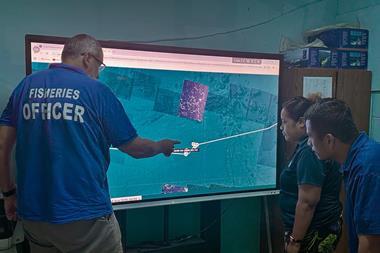



Seafood safety experts from the US Food and Drug Administration and the University of Maryland Joint Institute for Food Safety and Applied Nutrition (JIFSAN) are training 10 scientists from Bangladesh on how to eliminate health hazards from aquaculture.
The trainees are among a group that participated in a Good Aquacultural Practices (GAqPs) train-the-trainer programme in Khulna, Bangladesh, in November 2009 and who are committed to furthering their country's ability to further improve aquaculture safety there over the next five years.
The training, by experts from the FDA and JIFSAN took place 15-18 September, at College Park, Maryland, and will again take place from 20-24 September at university facilities in Princess Anne and Cambridge.
The emphasis is on hazards associated with shrimp production and on FDA regulations regarding safety of seafood imports.
"Collaborating with other countries in this way not only helps to improve the quality and safety of their domestic product, but also what they export to the United States and other countries around the world," said FDA deputy commissioner for international programmes, Murray Lumpkin.
The training will include lectures, demonstrations, site visits, and workgroup activities. Using a "train-the-trainer" model, those who successfully complete this and subsequent training programs will be qualified as trainers in Bangladesh.
This training programme was developed by a team of seafood specialists in 2006 and began in Vietnam that same year. Since then it has been conducted in Thailand, Indonesia, Bangladesh and, most recently, Malaysia.
This training follows the 22 March 2010 Agreement of Cooperation between the University and the Bangladesh Shrimp and Fish Foundation (BSFF).
The next Bangladesh train-the-trainer programme is scheduled to take place 7-11 November.