



A collision between Brazilian and Chinese longliners in international waters appears to be the latest incident in an escalation of competition for fishing grounds in the South Atlantic. This time it has led to accusations from both sides, and has also triggered a spate of politically-motivated fake news that has been shared thousands of times on social media, despite having been shown by a fact-checking agency to be false.
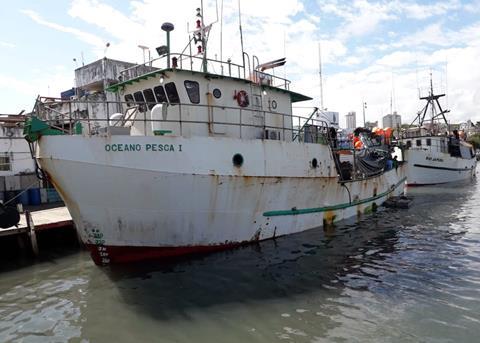
24 metre Brazilian tuna vessel Oceano Pesca 1 was fishing 430 nautical miles east of Natal when it was involved in an altercation with Chinese fishing vessel Chang Rong 4, resulting in the Brazilian vessel having to cut its trip short to seek repairs. According to skipper Carlos Derlando Brandao, the Chinese vessel caused a deliberate collision, and attempted to do so again. He commented that minor conflicts with Chinese fishing vessels are common and are generally occur over entangled longlines, but he said these conflicts do not take place with Spanish or Japanese vessels, reports Eduardo Campos Lima.
“Our lines are shorter and lighter than theirs. When our gears occasionally cross theirs, they frequently just cut our lines and let them sink,” he said. “The Chinese are aggressive and try to intimidate us with their big vessels,” he added.
Conflict over fishing gear sparks accusations and fake news
Carlos Derlando Brandao and his crew had been fishing for tuna in the area for eight days, and expected to be at sea for another ten when the incident took place, reports Eduardo Campos Lima.
“We were about to haul our lines when we detected a vessel on the AIS heading towards our position. I didn’t see any problem with this, as these waters are crowded with fishing boats from all over the world,” he said.
But the vessel, which they identified as 49 metre Chinese tuna longliner Chang Rong 4, approached dangerously close Oceano Pesca I’s stern. The Chinese crew reportedly threw items at the Brazilian vessel, and made menacing gestures.
“So they hit the port side of our vessel at high speed. They signalled that they intended to sink the boat,” he said, recounting how the Chang Rong 4 spent 40 minutes trying to engineer a second collision, but the smaller Oceano Pesca 1 was able to manoeuvre faster than the larger vessel and escaped further contact. Skipper Brandao radioed for help and another Brazilian vessel arrived four hours later. They were able to make temporary repairs to two holes above the waterline, and while Oceano Pesca 1 steamed home, its owners dispatched another vessel to haul its fishing gear. Owner Everton Padilha estimates the loss at £100,000.
Competition for access to fishing grounds in the Southern Atlantic appears to be on the rise, and Chang Rong 4’s owners China National Fisheries Corporation (CNFC) issued a statement following the incident, stating that gear theft is common – and their complaints mirror those of the Brazilian fishermen.
“The position where heavy loss was made to the vessel’s fishing gears was just the position where the Brazilian Vessel Oceano Pesca 1 was,” said CNFC in a statement issued by its general manager Sui Hengshou, stating that the loss of 35 buoys and a large amount of longline in that position the previous day had sparked the incident.
“Chang Rong 4 found the Brazilian vessel again and sailed toward it, intending to claim back the lost buoys. Close to S05°13’W 28°03’, Chang Rong 4 caught up the Brazilian vessel and, through VHF radio, requested if it could stop for a while and return the stolen fishing gear. However, the Brazilian vessel did not want to listen and was sailing away faster.”
According to CNFC, there were difficult sea conditions at the time of the incident and Chang Rong 4’s slightly touched the port side of Oceano Pesca 1, causing a small dent on the hull, but resulting in no serious damage or any injuries
“Then the Brazilian vessel threw eight buoys into the seawater, which were recovered by Chang Rong 4 and identified to be the exact buoys it lost. Chang Rong 4 then left Oceano Pesca 1 [and] went back to the fishing ground, where it continued to haul lines,” CNFC stated, and accuses Brazilian vessels of stealing 107 buoys, 1800 hooks and 100,000 metres of main line from their vessels since the end of October. The Brazilian Navy is investigating the incident.
Fake News
The incident with Oceano Pesca 1 follows on from the highly polarised Brazilian presidential race in which Jair Bolsonaro was elected after a very aggressive campaign against Workers’ Party (Partido dos Trabalhadores, or PT) candidate Fernando Haddad. The right-versus-left race raised animosities throughout the country and fake news were heavily disseminated through WhatsApp and Facebook – and the news of a Chinese vessel reportedly attacking a Brazilian fishing boat went viral on social media, sometimes with the facts seriously distorted.
A far-right Congressman for three decades, Bolsonaro gained notoriety due to his controversial comments against human rights and an standpoint favorourable to the military junta that ran Brazil between 1964 and 1985. During his campaign, he accused his centre-left opponent Haddad and former Brazilian president Dilma Rousseff (also a member of PT) of being communists with plans to implement a Venezuelan-like regime in Brazil.
As soon as the first reports on the conflict with Oceano Pesca 1 started to appear, a distorted version was distributed on social media. The fake version combined the story told by skipper Carlos Brandao and false comments made by the Chinese ambassador to Brazil, Li Jinzhang, implying links between PT and communist regimes all over the world.
While having been shared many thousands of times in spite of having been conclusively disproved by fact-checking agency Lupa, the online version of the story falsely claimed that China’s ambassador to Brazil, Li Jinzhang, had stated that Oceano Pesca I had been the aggressor, while the fake story also made the further false claim that during Dilma’s administration, Brazil had signed a treaty ceding part of its coastal grounds to the Chinese fishing operations for 25 years, including exclusive rights to tuna fishing.