





Customers want a craft product – no additives
It’s not hard to find JC David in Boulogne’s Capecure fish processing district. You just have to follow your nose and the enticing aroma of fish being gently smoked that takes you to the company’s door.
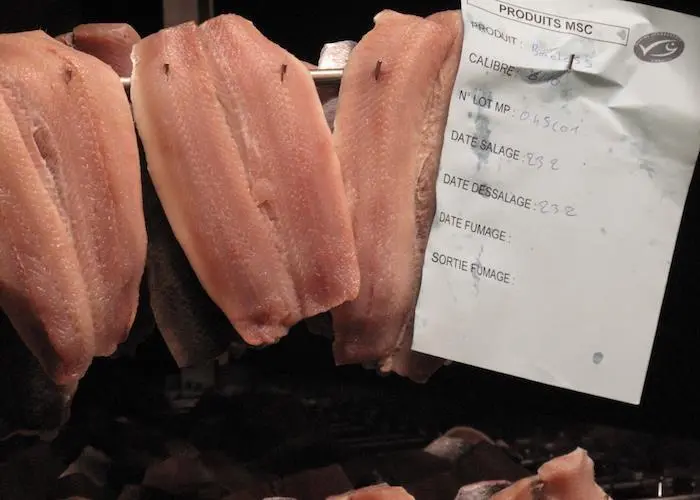
Nine hundred tonnes of salmon, haddock, herring and mackerel pass through the traditional smoking ovens at JC David, and Laurent Gressier said that while there are other fish smokers in Boulogne who use a combination of electric and traditional techniques, they have stayed with smoking fish over oak sourced from sustainably managed woodlands.
He explained that this is work that calls for skill and intuition, as the smoking process depends heavily on ambient conditions. Rain and fair weather call for different compositions of of oak sawdust, chips and logs in the fire to ensure the right burn rate and temperature, just as strong winds inevitably push more air through the ovens and a drop in temperature will call for a bigger fire in each basement oven during the long process of smoking the fish on racks in the smoking cabinets above.
The smoke temperature needs to be maintained between 20 and 25°C, and the smoking process takes 16 to 20 hours, with the smoking time also a factor that varies according to the conditions. Fish placed in the smoking cabinets at eight in the morning is generally ready to be taken out and processed or packed at four the following morning.
“The fish are smoked all through the night, and some of the staff start at four in the morning to take out the trays, the packing teams are here at five and the office staff at six,” he said.
While the oak comes from France, raw material is imported, and everything is MSC certified. Haddock comes from Iceland, herring from Norway and mackerel from Ireland, all of which are supplied frozen, while the salmon is Scottish and comes fresh.
“The MSC requirement is definitely important for the French market now,” he said. “Four or five years ago, it was just Germany that wanted this and nobody in France was interested. But now the French market is demanding this as well.”
“We’re producing a range of products for the top of the smoked fish market. Customers want a craft product, with no additives and they want MSC certification – and they are prepared to pay for it,” he said, adding that as well as MSC certification, JC David products have won numerous awards over the years and their herring carries the Label Rouge badge.
“There are no preservatives. The recipe is fish, salt, water and smoke. The real complexity and skill is in the smoking process,” he said.
From these four species, JC David produces a range of more than a hundred products for a variety of different markets, including export markets in the US, Asia, Dubai and Eastern Europe.
“We produce the traditional yellow smoked haddock that goes to a lot of top restaurants, and there’s a growing trend for white haddock that we started producing without the colouring in October, and that’s for the French market so far,” Laurent Gressier said.
“The French market is growing at between 5 and 10% every year, and we also export approximately 10% of our production – which we would like to increase,” he said, commenting that the smoking cabinets are being extended upwards to the next floor of the building, so that smoke from each oven will be routed through an additional line once the twenty new cabinets are ready at the end of 2019, expanding the company’s production capacity for traditionally smoked fish.
Related Articles
 PROCESSING & REFRIGERATION
 SEAFOOD
 SEAFOOD