




Constant low-temperature cooling for Japan’s Burimy Inc.
Sunwell Technologies Inc. of Canada continues to sell its Deepchill Variable-State Slurry Ice Systems into Japan. In December 2006, Burimy Inc. of Amakusa-city, Kumakoto, Japan installed a Deepchill System at its fillet processing plant.

Burimy is one of the most successful fish farming/processing companies in Japan. It processes about 1,500 tons of fish a year, including yellowtail, amberjack, red sea bream, hardtail and Japanese horse mackerel. In June 2003, it became the 19th company in Japan and the first private company to receive the Japanese Administration Certification as a seafood handling facility to export seafood to EU countries. It sells 40% of its production in Japan, and 60% overseas in the USA, Canada and EU countries.
Burimy’s objective in installing the Deepchill System was to provide constant, low-temperature cooling throughout harvesting and processing, for the preservation of its fillets and dressed product. The Deepchill Variable-State Ice System at Burimy uses 20°C seawater to produce as much as 6.6 tons of dry ice or 18.5 tons of deepchill slurry ice per day. Sunwell’s Marketing Manager, Gabriel Lopez says; “Burimy wanted to provide higher quality product for overseas and domestic markets and to improve working efficiency. The Deepchill System allows them to maintain a consistent fish product temperature just below 0°C from harvesting to shipping.”
Before installing the Deepchill Ice System, Burimy used a crushed ice and seawater mixture for bleeding the fish at the farm and for chilling in the processing plant. Early in the morning, two employees stirred ice and water in the bleeding tanks for two hours. They then moved the tanks to the dock, and loaded them onboard the boat, which would carry them to the fish offshore preserves 15 minutes away. With the Deepchill System, the process is as simple as pressing a button to initiate the automated Delivery System which pumps the deepchill ice from the insulated Deepchill Storage Tank located just beside the processing plant, to the bleeding tanks on the dock, about 180m away. The deepchill ice is delivered with a temperature of –1.7°C.
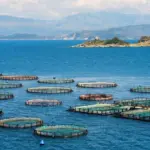
Yellowtails are loaded onto the operating boat from the small fish preserves on the farm. They are killed quickly with a bleeding machine onboard the boat, and then placed into a tank on the dock, containing deepchill slurry ice with a 25 to 30% ice fraction (ice percentage in the deepchill). Submerged in the deepchill, 5kg yellowtails stop moving within two to three seconds, reducing stress and better maintaining the fish quality. The fish no longer move aggressively as was the case when conventional freshwater ice and water was used.
When initially placed in a tank onboard, the fish temperature is 16°C. The boat then returns to the dock and the fish holding tanks are delivered to the processing plant where the fish are left to cool for about one hour, lowering the temperature to 4°C. Even with the fish in the tank, the temperature of the deepchill remains at –1.5°C, proving that the slurry ice does not melt faster than traditional forms of ice.
From there the fish are processed, cleaned, and once again placed in deepchill ice for an additional 30 minutes at –1.5°C, bringing the fish temperature down to 0°C. The fillets and ready-to-cook fish are dried off, packed and shipped.
The Plant Manager, Keigo Hama says, “I already knew that slurry ice is effective for cooling saury. The freshwater ice mixture we used to use couldn’t effectively cool down the fish sufficiently because the bottom portion of the tank was always above 0°C. Even at the surface it was 0°C. When the fish is not properly cooled, there is internal thermal deterioration, the filleting machine easily scratches it and it has a dull appearance. We used to have a 5% loss from all of the production. Now that we use deepchill slurry ice, we find that the fish-body is clear and elastic and the quality of the fish is higher. And the working efficiency is up as well.” He pointed out also that another advantage of the deepchill ice is that it isn’t super-cooled and doesn’t damage the fish, a common disadvantage of traditional seawater ice.
Related Articles
 PROCESSING & REFRIGERATION
 SEAFOOD
 SEAFOOD