




It has been more than two months since Chile''s fishing industry was obliterated by an 8.8 earthquake and tidal waves. Many fishermen feel let down by ineffective government reconstruction measures.
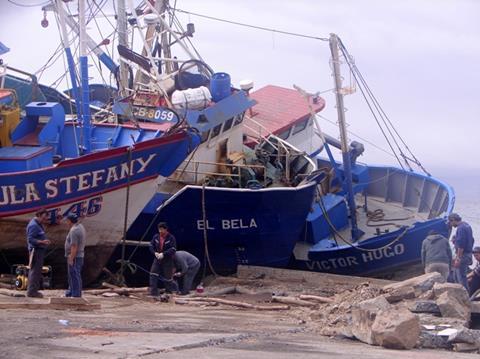
More than two months after seeing their industry obliterated by an earthquake that measured 8.8 on the Richter scale and a subsequent volley of tidal waves, many Chilean fishermen are still without homes and a means to earn a living, reports Ian Emmett.
Chile’s artisanal fishing industry is mainly concentrated in the Bío-Bío Region, which was the epicentre of the 27 February earthquake.
The earthquake was followed by a series of devastating tsunamis that battered the region’s 600km coastline and damaged or destroyed an estimated 60% of the country’s fishing industry.
While the disaster was a natural phenomenon, Chile’s government has been slammed for dragging its feet and failing to put effective reconstruction measures in place.
Today, in Dichato, which was one of the most affected fishing ports in the region, many fishermen and locals who lost their houses, boats and possessions are still living in tents and other forms of makeshift accommodation.
A handful of Chilean companies have taken matters into their own hands. For example, a private boat repair company from Valdivia has to date repaired 12 fishing boats in Dichato and the equally devastated port of Coliumo. This company has had no government funding and has only asked for its food and accommodation costs to be met.
Meanwhile, fish is back on sale albeit at inflated prices in many cases, and the industry has speculated that full recovery will take about two years.
Stakeholders suggest the main problem is Chile’s fishing industry lacks a Ministry of Fisheries. The country’s highest authority is the Subsecretary of Fisheries under the Ministry of Economy, Development and Tourism.
This ministry has, however, launched measures to reactivate the ailing artisanal fishing industry. These include up to 25% funding of costs for replacing or repairing boats up to 12 metres, engines and fishing gear, for a maximum amount of CLP2.1 million (EUR 3,130/$4,060) per beneficiary.
Neither fishermen nor shipowners actually receive cash as this is channelled directly to the private supplier companies.
To finance the remaining 75%, soft credits are being made available, with the guarantee of the Chilean economic development agency Corfo. Private sector concerns are meeting 50% of this 75%, so fishermen only have to finance the remaining 25%.
Juan Andrés Fontaine Talavera, Minister of Economy, Development and Tourism, along with Pablo Galilea Carrillo, the new Subsecretary of Fisheries, received a donation of $1 million (EUR 770,500) from the FAO for the artisanal fleet in the areas most affected by the earthquake or tsunamis.
Over the next six months, the ministry will make the system more flexible for artisanal fishing by allowing other fish species to be caught for human consumption.