




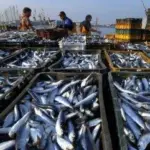

Bumper US highlights Europe’s woes
Exports of US seafood continue to grow dramatically in value and volume, according to the US Department of Agriculture (USDA).
This data, reports Peter O’Neill, comes just as Unilever announced a selloff of its EU frozen fish operations across the EU [see inside, page 5]. The USDA says seafood exports to the EU were 267,478 tonnes from Jan-Nov, 2005, up 13 per cent at nearly $849 million.
Some analysts suggest majors like Unilever want out of European processing as they see developing countries, with own stock, capturing more value-added markets. Perhaps the EU could lose out to them in the battle for raw material from countries such as the US which will go where the best prices are and processing labour is cheaper.
US world exports were up at $3.7 billion for Jan-Nov 2005. That includes its top five markets of Japan, EU, Canada, Korea ($387 million) and China, the latter up a massive 15 per cent at $334 million.
EU dependence on the US shows in scallops alone which “rocketed to $62 million”, 94 per cent up over 2004; US surimi to Europe has risen 864 per cent since 1996 to 33,654t in 2005, mainly from Alaska pollack, and US cod exports to the EU are up 300 per cent since 1996.
Germany, Europe’s number four processor, now buys in 75 per cent of fish to feed its processors, 60 per cent of that non-EU.
The USDA says the EU has one of the world’s highest seafood trade deficits with 2004 imports costing €12 billion and EU exports worth only €2 billion. “The deplorable state of certain EU fishery stocks and the reduction in annual catch quotas make the EU more and more dependent on imports…[and] 82% of total [2004] EU fish imports were non-processed fishery products.” It added that between 1995-2003, the EU’s 25-member catch decreased by 26 per cent. Denmark’s has plunged by 48 per cent.
Related Articles
 FISHERIES
 FISHERIES
 WORLD FISHING EVENTS