



ASC hosts update meeting
The latest Aquaculture Stewardship Council (ASC) Update meeting was held during the European Seafood Exposition 2013.
During the meeting, Chris Ninnes, the ASC’s CEO, announced that the trout, bivalves (clams, mussels, oysters, scallops) and abalone farm certification programmes for responsible aquaculture will be launched this year, and that the salmon standard has been approved by the ASC governance and audits can start immediately.
Currently 14 trained certifiers are qualified to start salmon farm audits globally. A second training is planned for late 2013 and the first ASC certified products for responsibly farmed salmon are expected in the market by the end of the year. Villa Organic, a Norwegian producer, will announce its first ASC Salmon audit shortly.
He also announced an initiative to consolidate feed requirements across all of the existing ASC standards into a single Feed Standard to help the aquaculture feed industry to operate in a more environmentally and socially responsible way. This will be a joint initiative between GAA, GLOBAL G.A.P, the MSC and SFP. It will be managed by the ASC and is expected to be concluded by the end of 2015.
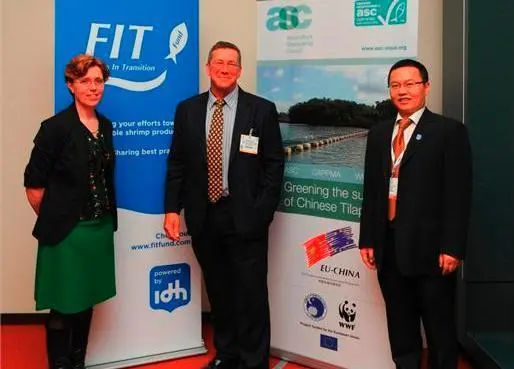
Mr Cui He, Vice Executive President and Secretary-General of CAPPMA also joined the meeting to speak about the ‘Greening the Supply of Chinese Tilapia’ project. The project was launched in 2012 as a joint initiative between ASC, CAPPMA and WWF China to help Chinese tilapia producers to operate in a more environmentally and socially responsible manner. The project has been made possible by a grant of €1 million from the European Union EU-China Environmental Governance Programme.
“Through the ‘Greening the Supply of Chinese Tilapia’ project, CAPPMA will direct Chinese tilapia farmers towards complying with the global ASC Tilapia Standard for responsible aquaculture”, said Mr Cui.
The Farmers in Transition Fund (FIT) has been created by the Sustainable Trade Initiative (IDH) to stimulate and support the production of responsibly farmed shrimp that will help reduce environmental and social impacts of aquaculture. It partners with retail and food service companies to encourage suppliers to improve their farming practice and actively engages governments, sector and other stakeholders in the countries of production.
“Our Farmers In Transition Fund is a market-driven programme that encourages suppliers to invest in more responsible practices. By supporting those farmers real improvement under water is being achieved and the increasing demand for responsibly farmed shrimps is being served”, said Esther Luiten, IDH Senior Program Manager Aquaculture.
Related Articles
 FISHERIES
 FISHERIES
 WORLD FISHING EVENTS