



The Argentine anchovy (Engraulis anchoita), management unit Bonaerense, semi-pelagic mid-water trawl net fishery operating in the area administrated by the Joint Technical Commission of the Maritime Front (CTMFM) and north of 41ºS in the Argentine Sea, has entered full assessment in the Marine Stewardship Council’s (MSC) certification programme for sustainable and well-managed fisheries.
The fishery will be assessed by an independent certifier against the MSC standard for sustainable fishing. If successful, products from this fishery will be eligible to bear the blue MSC eco-label.
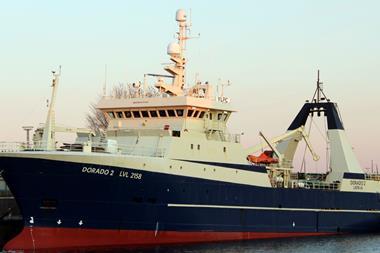
The clients for this assessment are Delicias SA and Centauro SA, and together they have five coastal and long range ice chilling vessels operating from August to November. If successful, the clients have expressed their willingness to share the MSC certificate with other eligible anchovy fishers in the area.
There are two management units in Argentine Federal Waters, North (Bonaerense) and South (Patagonico) of 41ºS. This assessment covers the Bonaerense unit only.
The 2010 total allowable catch (TAC) for the Bonaerense Argentine anchovy is 120,000 tonnes. In 2009, the total capture of Bonaerense anchovy was 27,695 tonnes, with the client group catching about 15-20% of this amount.
Argentine anchovy is primarily used for human consumption. Eighty percent of the catch is exported and the rest is for internal Argentine markets, with the most important export markets being Spain and Peru.
Products derived from the fishery include anchovy fillets in oil, vacuum-packed anchovy fillets, anchovies in brine, salt-cured anchovies, anchovy fillet marinated in vinegar and whole frozen anchovies.
Carlos Rodriquez, speaking for the clients said: “The sustainability of the resource is a fundamental part of our vision as a company that works for environmental, social and economic sustainability, generating benefits that go further than our daily labour.
“That is why, beyond the new and positive steps in fisheries management, we have decided to join the MSC certification process as a journey that will highlight our work and the work of all those in different sectors who contribute to the management of natural resources in a balanced, serious and responsible manner.”
Kerry Coughlin, the Americas regional director for the MSC, said: "Fisheries in South and Central America are important sources of seafood for global and domestic markets, and regional participation in the MSC program is increasing as worldwide sustainability awareness and demand grows. We hope this fishery successfully completes the assessment, creating incentive for other Latin American fisheries to pursue MSC certification.”
The client contracted with Organización Internacional Agropecuaria (OIA) to conduct the independent, third-party assessment, which is expected to take approximately nine months.
A team of scientific experts will be convened to evaluate the fishery based on the three principles of the MSC standard: the sustainability of the fish stock, its impact on the environment, and the management system in place.