

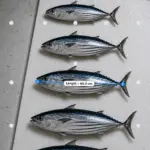


Albacore fishing in the South Pacific
A report (Oceanic Fisheries Programme Technical Report No. 37) just published and written by Adam D. Langley of the Secretariat of the Pacific Community, summarises the status of the stock and fishery management issues pertaining to the Pacific Island Countries and Territories (PICT*).
Since the early 1990s, there has been a substantial development of domestic tuna longline fisheries within the subequatorial region of the South Pacific. Domestic fleets have developed in many of the countries of the region. These domestic fleets are typically composed of smaller vessels operating within their national waters and adjacent areas. The catch is fresh chilled and generally discharged at the vessel’s home port.
The Secretariat of the Pacific Community report expresses the view that analysis of current (2005) stock assessments for South Pacific albacore indicate that there are no sustainability concerns regarding the overall stock, and that substantially higher yields could be taken from the fishery. However, this conclusion does not adequately address the management issues faced by the domestic longline fleets in PICTs.
The PICT fisheries principally catch larger, older (7–12 years) albacore.
These age classes represent a relatively small proportion (about 30%) of the total adult biomass of albacore. Recent levels of fishing effort from all fisheries combined have reduced the level of biomass available to the PICT domestic longline fisheries by approximately 30% compared to unexploited levels.
Regional effects
At a regional level, increases in fishing effort in the PICT domestic longline fisheries will result in declines in CPUE due to a decline in exploitable biomass. These impacts are likely to be considerably greater than the impact of large increases in the level of fishing effort by the distant-water fleets in the south-eastern area of the fishery. Catch rates in domestic longline fisheries exhibit strong seasonal trends.
For the longline fisheries in Fiji and French Polynesia, these trends appear directly related to seasonal fluctuations in the oceanographic conditions. Seasonal trends in fisheries in adjacent waters are likely to be influenced by similar variations in oceanographic conditions.
Inter-annual variation in albacore catch rates is also evident in most of the PICT fisheries. The sustained period of low catch rates that commenced in late 2002 appears to be attributable to inter-annual variation in oceanographic conditions.
Local impact
At a local scale, very high levels of fishing effort appear to be capable of causing localised depletion of albacore tuna. This is principally an issue for domestic longline fleets where fishing effort is concentrated in a relatively small area, largely due to operational constraints of the fleet.
The scale of the local depletion effect is likely to vary seasonally and inter-annually as the rate of exchange of fish with adjacent waters varies. Indications from the Fiji longline fishery is that, on average, catch rates may be reduced by about 20% at high levels of fishing effort.
As a result, management objectives of the PICT domestic fisheries need to balance levels of fishing effort with the availability of fish to the fishery to ensure economic sustainability of the fleet.
* PICT, the Pacific Island Countries and Territories, includes Fiji, Samoa, American Samoa, New Caledonia, French Polynesia, Tonga, and the Cook Islands.
Related Articles
 FISHERIES
 FISHERIES
 WORLD FISHING EVENTS