




Advances in aquatic animal tracking research
Advances in aquatic animal tracking over the past 30 years has broadened our knowledge of movements, migrations, interactions and survival, according to a new paper.
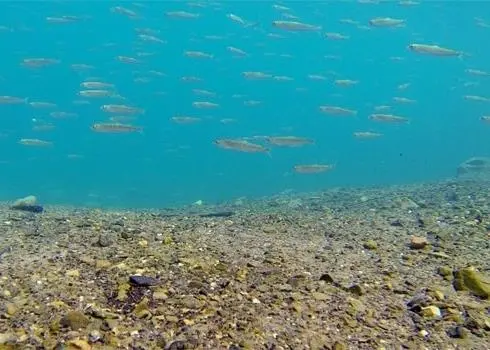
The paper, by Canadian research platform Ocean Tracking Network (OTN), looks over 20 examples of “scientific breakthroughs”, in global ocean observation science achieved through advancements in acoustic and satellite telemetry—tracking via electronic tags placed on organisms ranging from tiny neonate fish to large whales, which transmit data to fixed or mobile receiver stations or orbiting satellites.
Electronic tags can now weigh less than a penny, can transmit for more than 10 years, and can be attached to almost any species, at any life stage, to collect high-resolution data in four dimensions (2D-horizontal, depth and time).
“The vastness and impenetrability of the ocean has historically limited our ability to acquire and process information on animal movements,” explained Sara Iverson, scientific director of OTN and corresponding author on the paper. “Telemetry has significantly enhanced our capacity to predict and plan in the face of climate change and human influence.”
According to the paper, telemetry data have revealed the often-mysterious migrations of endangered marine animals like leatherback turtles, basking sharks, European eels and Pacific bluefin tuna. These discoveries, and the increasingly sophisticated technology behind them, generate critical knowledge towards conservation recommendations, says the OTN. Tracking studies also pinpoint successes and limitations of current management plans.
“In the future, we could be looking at spatially dynamic MPAs, which move annually with predictions of animals’ response to their environments,” added Nigel Hussey, lead author and researcher at the University of Windsor with the Ocean Tracking Network.
Now, acoustic and satellite telemetry studies are being combined with other biological measurements like genetic analysis or physiological status to help determine drivers behind animal behaviour to forecast how anthropogenic and climate changes will affect species and populations.
Aquatic animal movements and migrations transcend geopolitical, economic, and management boundaries, says the paper. Telemetry studies in the last decade have documented movement over transoceanic scales, to regions unreachable by humans, and into some of the harshest parts of the ocean, providing the groundwork for “next-generation aquatic governance frameworks.
“The ocean will continue to change. Global collaboration—among industry and science sectors, and researchers themselves—is imperative to get ahead of these changes before they catch up to us,” concluded Mr Hussey.
Related Articles
 FISHERIES
 FISHERIES
 WORLD FISHING EVENTS