



Adding value the way forward for pangasius
In the first nine months of 2014, the value of Vietnam’s exports of frozen pangasius products remained more or less static at $1.28 billion, a slight rise of 0.2% compared with the same period last year.
Figures from Vietnamese Customs show that exports to the two major markets, the EU and USA, dropped significantly. Sales to the EU were down by 8.4% at $261.02 million and to the USA by a massive 16.7% at $240.81 million.
These declines were countered somewhat by an increase in the value of pangasius sales to the ASEAN group of countries which grew by 12.4% to $102.68 million.
Until the third quarter of 2014, the USA had been Vietnam’s largest market for frozen pangasius fillets, but it has now been overtaken by the EU with Spain, the Netherlands, Germany and the UK the leading importers. According to industry observers, while sales to the UK have remained steady, sales to continental European markets have declined due to ongoing bad publicity and the availability of other cheap whitefish species.
However, rather than try and compete at the bottom end of the European market where business is cut throat and margins are slim with prices at about $2.60-2.70 per kg CIF for skinless IQF pangasius fillets, forward looking companies are starting to introduce value-added pangasius products.
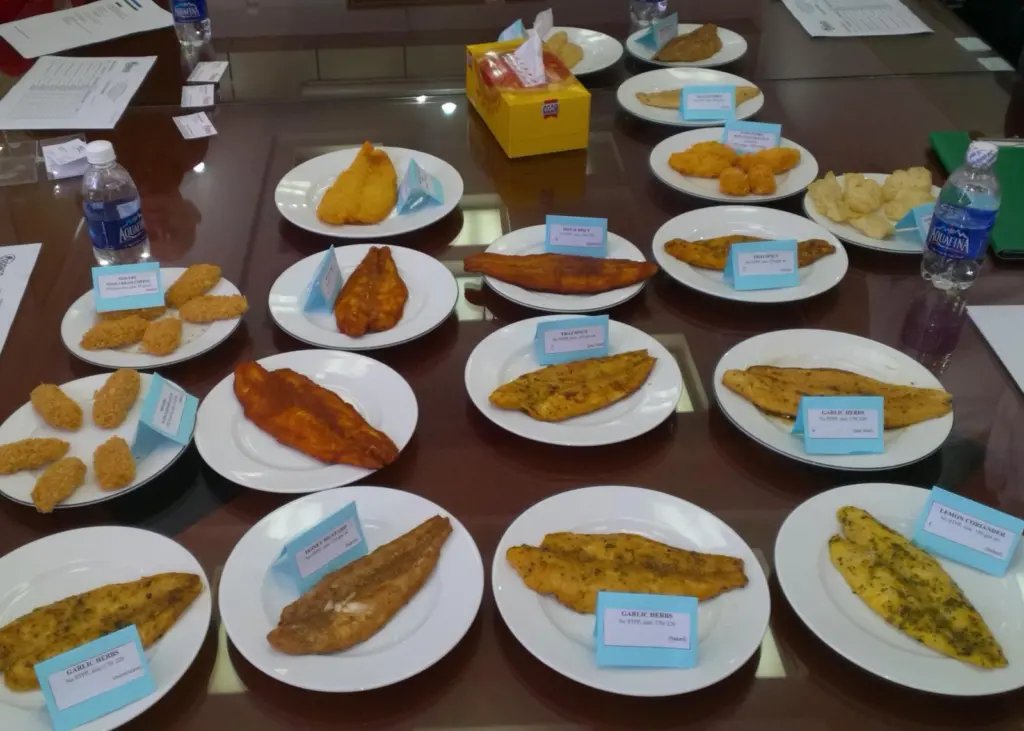
The two most common lines are pangasius fillets marinated with flavours such as lemon grass, lemon pepper and coriander, and breaded fillets. Both products are proving popular in supermarkets in Belgium, the Netherlands, Germany, Croatia and the UK, and there are reports that sales will be expanded to other countries. Prices paid to Vietnamese exporters for marinated pangasius fillets are about $5 per kg.
Coated
With regard to breaded pangasius, fillets or fillet pieces coated with Japanese style ‘panko’ breadcrumb show real promise. Panko breadcrumbs are larger than the usual breadcrumbs used to coat seafood products and with a rough texture give a more crunchy texture.
These products are fat free, or low in fat to comply with healthy eating guidelines and flavours such as cream cheese can be added to the crumb to broaden their appeal.
Vietnamese authorities have tried, and failed, for years to persuade Vietnamese exporters to increase plain IQF pangasius fillet prices to $3 per kg and above in order to provide a better return to farmers who are increasingly giving up on pangasius. “There is no profit now, the competition is so fierce,” said an industry observer.
Unfortunately, as often happens in the seafood industry, Vietnamese pangasius processors are effectively cheating by binding in water to their products to reduce the price. This is done in two ways: by tumbling in polyphosphate or other solutions before freezing, and by adding extra glaze after freezing. (Often both practices are carried out on the same fillets.)
In a recent survey by the EU veterinary service, IQF pangasius fillets were found to contain more water, at up to 40%, than other whitefish fillets such as plaice, cod and saithe, providing yet more bad publicity. However, while ‘cheating’ is still possible with both marinated and breaded products, it is thought these value-added lines will give pangasius a new lease of life.
Related Articles
 PROCESSING & REFRIGERATION
 SEAFOOD
 SEAFOOD