



Action urged on deep seas by UN
Swift and wide ranging actions are needed to conserve the world’s entire marine environment amid fears that humankind’s exploitation of the deep seas and open oceans is rapidly passing the point of no return.” So says a new report produced by the United Nations Environment Programme (UNEP) and the World Conservation Union (IUCN).
The report, entitled “Ecosystems and Biodiversity in Deep Waters and High Seas”, argues that the many lessons learnt on conserving coastal waters should be adapted and applied right across the marine realm.
Vulnerability of resource
According to Ibrahim Thiaw, Acting Director General of IUCN, “Well over 60% of the marine world and its rich biodiversity, found beyond the limits of national jurisdiction, is vulnerable and at increasing risk. Governments must urgently develop the guidelines, rules and actions needed to bridge this gulf. Otherwise we stand to lose and to irrevocably damage unique wildlife and critical ecosystems many of which moderate our very existence on the planet,” said.
With more than 90% of the planet’s living biomass found in the oceans, the report underlines the value of the deep seas and open oceans and highlights how science is only now getting to grips with the wealth of life, natural resources and ecosystems in the marine world. Less than 10% of the oceans have been explored with only one millionth of the deep sea floor having been subject to biological investigations.
The report also highlights the way fisheries, pollution and other stresses, such as from global climate change, are impacting on the marine world.
“Once limited largely to shipping and open ocean fishing, commercial activities at sea are expanding rapidly and going ever deeper. Fishing, bioprospecting, energy development and marine scientific research now take place at depths of 2,000 m plus,” says the report’s author, Kristina M. Gjerde, High Seas Policy Advisor to IUCN’s Global Marine Program.
In the report the author outlines options aimed at charting a course for progress in the conservation and sustainable management of the deep seas and open oceans.
Global fishing performance
• In the last 42 years, capture of wild marine fish for human consumption increased from 20 million tonnes to 84.5 million tonnes, with more than 40% entering international trade.
• Global by-catch amounts to 20 million tons a year, approximately 25% of the fish caught.
• Over half (52%) of the global fish stocks are fully exploited. Overexploited and depleted species have increased from about 10% in the mid 1970s to 24% in 2002.
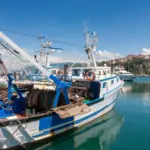
• Around 3.5 million fishing boats use the world’s ocean. 1% of these are classified as large, industrial vessels, with the capacity to take around 60% of all fish caught globally.
• Catch from high seas bottom trawl fishing in 2001 was worth an estimated US$300-400 million, equal to approximately 0.5% of the value of global marine catch. The sector employs an estimated 1,000-2,000 people using around 250-300 vessels.
• Global value of Illegal, Unreported and Unregulated (IUU) catches is between US$4.9-9.5 billion. Up to 30% of IUU fishing (US$ 1.2 billion) occurs beyond national jurisdiction.
Related Articles
 FISHERIES
 FISHERIES
 WORLD FISHING EVENTS