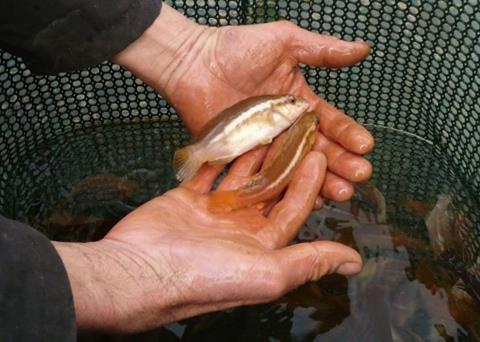
The SAIC says the project, which is now rolling out on Scotland’s west coast, has the potential to increase productivity on salmon farms and reduce the use of medicines in the industry, since wrasse can co‐habit with salmon in the same pens and can be used as ‘cleaner fish’ to remove sea lice from the salmon.
“Our grant funding has galvanised an industry-academic collaboration that not only leverages substantial investment, but will feed into the Scottish economic growth,” said Heather Jones, CEO, SAIC.
Atlantic salmon is the UK’s largest food exports, and with demand for Scottish salmon increasing in traditional markets such as the US and France, and emerging markets such as China, the Scottish government has set increased production targets for 2020. SAIC says progress on the use of cleaner fish such as wrasse and lumpfish to control sea lice on fish farms will support the industry’s work to raise production.
According to the SAIC, the project could also lead to the creation of new jobs in rural communities, not just in salmon production but in wrasse production and management.
Previously, the use of wrasse in fish farms involved the collection of wild wrasse, a solution which SAIC says is not sustainable. This new project is expected to solve bottlenecks limiting productivity and improve the quality and delousing efficacy of farmed wrasse.
SAIC’s project will look at hatchery technologies, optimisation of cleaner fish welfare in salmon cages and prototyping in the commercial environment.
Project outcomes will include commercial protocols, research tools and a new knowledge of the biology of the ballan wrasse. SAIC says this will permit production of a handbook that individual farmers in Scotland – including SMEs – can use as a beginning-to-end guide on the breeding and husbandry of farmed wrasse.
SAIC has awarded grant funding of £831,530 to the project. This has leveraged contributions worth over £3 million from Marine Harvest (Scotland), Scottish Sea Farms, BioMar and the University of Stirling.