


Worlds largest fish defrosting plant
Peter Stette AS has delivered a top of the line defrosting plant. As far as the company knows, Brødrene Sperre in Ellingsøy outside of Ålesund in Norway, now has the worlds largest capacity in defrosting whitefish for production of salt fish.
Challenge
Peter Stette AS was given following challenge by Kjartan Stokke, the production manager at Br. Sperre:
• The plant must have capacity to defrost 120 tons per day of frozen fish
• The fish must be thawed to best quality by controlling the temperature
• The energy in seawater must be exploited
• It must be possible to run the plant with a small crew and also unmanned
• The products are frozen blocks and single frozen products
• The plant must handle large quantities of fresh fish and work as a storage tank or buffer tank
• Optimal logistics concerning full/empty pallets and packaging waste
• Thawed fish should be called upon from operators on a clipfish machine several hundreds metres away
The reasons for choosing Stette was the company’s base of knowledge in defrosting seafood and its ability to visualise by means of a 3D-model. With the 3-D model it was possible for the customer to see its new daily routine from every possible angle.
Construction
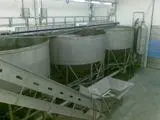
The defrosting plant is build up of three circular tanks containing 80m3 and the plant will have a defrosting capacity of up to 40 tons of thawed fish per batch per tank. Several PLC systems control the defrosting plant and these are developed over many years and many deliveries from Stette. All defrosting plants delivered by Stette have the same software. GSM modems are installed to be able to monitor and service during production.
Function
The raw material comes frozen from the cold storage plant situated near to the defrosting plant. Pallets with blocks are accumulated towards an unpacking station and up to 30 tons can be inserted at the same time. Two to four operators unpack the fish in working station and all the packaging is automatically handled into a waste compactor.
The correct position is provided by lifting tables and when empty pallets go out from one side, the other side is supplied with fully loaded pallets.
Operators decide where to ship the frozen blocks by means of the conveyors over the defrosting tanks.
After filling the defrosting tanks, the process of defrosting can start. A set of parameters is punched into the software and the optimum defrosting curve is set for the product.
As production starts, the system is set to production mode. When this mode is set, the operators on the production line can control the transportation of fish.
The fish is pumped 200m in pipes outside of the building to the clipfish machine. The fish is transported gently in chilled water all the way to the production area.
Large profits
The capacity that Brødrene Sperre has gained is unique in salt fish production. With its top of the line logistic solutions, Stette says that the effectiveness of the plant will give Brødrene Sperre the advantage to be a world leading producer of salt fish.
The quality of the fish is kept high with the use of the software installed, and the yield and quality grading is increased by defrosting with the equipment and software from Stette.
Summarised, Stette says that the investment is a technological leap for both Br. Sperre and the industry with regard to logistics, quality and yield.
Related Articles
 PROCESSING & REFRIGERATION
 SEAFOOD
 SEAFOOD