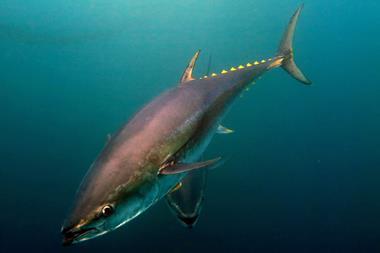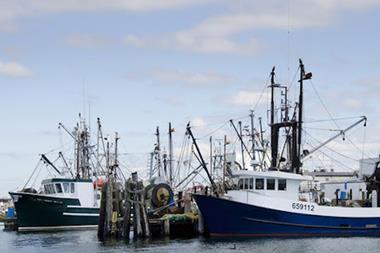




Tuna fisheries represent a heavily invested industry that operates highly mobile fleets of large expensive purse seiners and longliners.
Even the smallest tuna fishing vessels carry expensive deck equipment and fishing gear. Apart from catching, they include fattening of mainly bluefin tuna in cages. This sector, being based on catching and stocking fish in cages before they had a chance to spawn, cannot be considered fish farming.
Its advantage lies in the fact that relatively small fish taken by purse seiners, formerly sold only for canning, can after fattening be absorbed by the sashimi market, although at prices usually lower than those obtained by wild bluefin. The latter and a couple of other species, if delivered to 'sashimi markets' in the right condition, sometimes fetch incredibly high prices. Altogether, tuna fisheries represent an extremely important and touchy sector of world fisheries.
Even now there's a rather tumultuous squabble about the Atlantic/Mediterranean bluefin that some consider as being too heavily exploited. Recently, the EU has been trying to force French and Italian governments and their fishermen to stop using long driftnets in the Mediterranean. In the Bay of Bengal and the Indian Ocean, reports Santosh Patnaik in The Hindu, the Indian authorities suspended tuna fishing, chiefly because it seems to avoid deep waters. Because living in deep and cold waters causes the tunas to grow fat flesh that is sought after on sashimi markets, it is believed that due to hydrographic shifts in the area the tuna flesh quality declined and was not meeting the sashimi grade.
FAO's reliable reviews of world tuna fisheries are, therefore, important for the understanding of the state of these resources. The last one prepared by Dr Jacek Majkowski of the FAO Fisheries and Aquaculture Department, entitled 'Global fishery resources of tuna and tuna-like species', was published towards the end of 2007, with 2004 being the last year covered.
In scientific terms 'tuna' and 'tuna-like species' form the suborder Scombroidei, which comprises some of the largest and fastest marine fishes, including tunas, bonitos, seerfishes, small tunas, mackerels, and billfishes. Tuna species are very sensitive to environmental dynamics; sensitivities that change with age, hence marine climate fluctuations affect their distribution, abundance and availability.
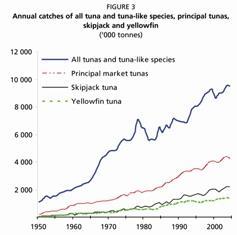
According to FAO, the global annual catches of all tunas and tuna-like species increase continually, reaching about 9.5 million mt in 2003 and only slightly declining in 2004 (see Figure), in total an approximately seven to eight-fold increase in 50 years. This disproves once again a widely publicised 'theory', which our readers may remember, that stated that: "the large predatory fishes worldwide, (which means mainly the tunas), shrivelled to one tenth of their original numbers since the start of industrial fishing". (See: “Nature” Stumbles, in World Fishing, August 2004).
The main tuna species are classified as: a) tropical (skipjack, yellowfin and bigeye), which mostly react well to exploitation and are capable of sustaining high yields; and b) temperate (bluefin and albacore), which are less productive and may be more susceptible to overexploitation. The principal market tunas (albacore, Atlantic bluefin, Pacific bluefin, Southern bluefin, bigeye, yellowfin and skipjack) are divided into 23 distinct stocks, of which four or five are moderately exploited, eight to 10 about fully exploited, and five to six overexploited or depleted, while the actual status of the Mediterranean albacore and two Atlantic skipjack stocks is unknown.
Dr Majkowski warns that the continuing profitability of tuna fisheries may lead to increased fishing intensity and overcapacity that could result in a significant deterioration in the status of some stocks of the tuna species. On the other hand, in his opinion, the catches of albacore in the southern oceans could be increased in a sustainable way, while those of skipjack in the western and central Pacific and possibly also in the Indian Ocean could be significantly increased, provided that bycatch of yellowfin and bigeye can be avoided.
The steadily increasing share of skipjack, now exceeding two million mt, is the largest in the world yield of market tunas. Skipjack is predominantly canned. Its catches may fluctuate because of high variability of its recruitment. Yellowfin, with some 1.3 million mt is the second in terms of weight, and while most of it is canned, more and more of it is sold both fresh and frozen. Bigeye is the third, and its high fat content makes it desirable for the sashimi market. The next by weight is albacore with some 220,000 mt and the last in weight, though not in value is bluefin.
The fact that much of the world tuna yield is taken either in international waters or within the exclusive economic zones (EEZ) of coastal nations that themselves haven't got the necessary catching capacity, and that its stocks are as a rule shared by more than one nation, necessitates international collaboration in research and management of the tuna stocks. Worldwide, there are six Regional Fishery Management Organisations (RFMO) that deal with tuna conservation and management and two international scientific centres, one for the North Pacific tunas and the other for the South Pacific. It appears that there is quite good international collaboration in tuna research and in consequent advice to governments and industry. FAO's assessment and recommendations seem more trustworthy than those of North Atlantic management systems, because FAO does not pretend to provide ridiculously precise figures based on 'mathematisation' of obviously inadequate data, but explains the situation in qualitative terms.
What's missing in this 54-page report is an assessment of how the governments and the industry implement international tuna management agreements and programmes that FAO and other institutions have been trying for years to formulate and co-ordinate. Unfortunately, tuna fleets have overgrown the size needed for a sustainable fishery and they are inadequately controlled as to fishing effort, capacity, and catches. A question remains to what degree the implementation on national and industry levels of the scientific recommendations and regional and global agreements is lagging behind the available knowledge and advice.