


Back in 1867, President Andrew Johnson''s Secretary of State William Seward went shopping and returned home with a bargain: the whole and only Russian territory on the American continent – Alaska and the Aleutian Islands, which since 1859 was put on sale by the Russian Empire.
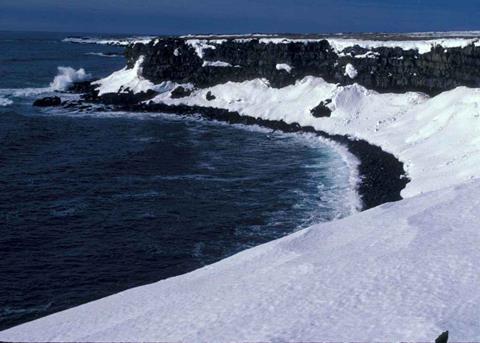
This deal was called throughout the American press ‘Seward's Folly’. Soon later, when in 1896 gold was discovered off Klondike River, the USA found that the ‘folly’ was not folly at all. In the years that followed since, more natural resources were discovered in Alaska. Today at over 1.5 million square kilometers, sparsely populated Alaska is the largest state of the United States, and supplies over 50% of the US foodfish yields, growing amounts of oil and gas, and some other minerals.
Until then, the Bering Sea - a marginal but, owing to interaction between currents, sea ice, and weather, a very productive Pacific Ocean ecosystem, had been practically surrounded by Russian possessions. Today, it is shared by the USA's and Russia's EEZs with international waters area nicknamed ‘donut’ at its centre. The Bering Sea covers over 2,000,000km2, (770,000 square nautical miles), and is bordered on the east and northeast by Alaska, on the west by Russia's Siberia and Kamchatka Peninsula, on the south by the Alaska Peninsula and the Aleutian Islands, and on the far north by the Bering Strait, which leads to the Arctic Ocean's Chukchi Sea.
Populating the Americas
Native Americans, all the way from Alaska down to Cape Horn at the southern tip of South America, are descendants of Mongolian people who had immigrated over tens of thousands of years from Siberia over the Aleutian Islands, then a land bridge, to eastern Alaska. Some of them settled there to make their living by hunting, whaling and fishing; others proceeded south to become the ancestors of Amerindians. It took the West Europeans, who colonized America since the end of the 15th century, 400 years to arrive in Alaska. The first Europeans to turn up there, in 1732, were Russian explorers on behalf of the Russian Empire that left Alaska in the hands of private fur traders, until Tsar Alexander II, in need of cash, let his brother Konstantin sell it to the US for US$7,200, or $4.74/km2.
According to Sergei Sayenko of the Voice of Russia everything changed after Klondike Gold Rush began and, in the 20th century, large oil and gas fields worth hundreds of millions of dollars were discovered in Alaska, now an actively developing US state with the highest per-capita GDP in the nation. Probably, this is why Alaska remains a thorny issue for many Russians, with some people even suggesting retaking the territory. But one can hardly imagine Russia launching a war against the US over Alaska.
Bi-lateral cooperation
The United States and the Russian Federation have a long history of working together on fisheries issues. This year marks the 25th anniversary of the Agreement between the governments of the United States of America and of the Union of Soviet Socialist Republics on Mutual Fisheries Relations, which set the stage for conservation, management and optimal utilisation of shared fisheries resources between both nations. Since, however, international fisheries resources have been increasingly sought after, and in some cases, due to increased demand for seafood products and illegal fishing activities - over-exploited.
Moreover, changing climate and ocean conditions over the whole Arctic Ocean, may present new challenges for international fisheries conservation and management. To address any new issues of common interest, NOAA and the Federal Agency for Fisheries of the Russian Federation signed in May a Joint Statement on Enhanced Fisheries Cooperation, which reaffirms the 1988 Agreement and identifies three major areas of future cooperation: 1) combating global Illegal Unreported and Unregulated (IUU) fishing; 2) collaborating on science and management of Arctic Ocean living marine resources; and 3) advancing conservation efforts in the Ross Sea region of Antarctica.
No wonder that the fisheries management in the Bering Sea and the rest of the reportedly warming Arctic Ocean was one of the foci of the Joint Statement, so that if indeed increasingly larger portions of the Arctic would become ice free in the summer, it should enable wider exploitation of fisheries and other natural resources. The USA is working with Russia and other Arctic nations to develop an international management mechanism for natural resources, as well as research aimed at understanding of the Arctic ecosystem required for fisheries management and conservation. While the research program will initially focus on the trans-boundary nature of North Bering Sea pollock, it is critical that the scientific community develops a sufficient understanding of the biophysical processes governing the region to assess the ecosystem impacts of climate variability and anthropogenic stressors.
Since 2008, the United States and Russia have been negotiating a fisheries law enforcement agreement that will enhance the ability of both governments to fight IUU fishing, both at sea and at market ends. In the spirit of an excellent history of cooperation in science, the USA and Russia hope to sign later this year this agreement allowing both governments to share information and coordinate among the full range of government agencies involved in fisheries law enforcement. The agreement would also emphasise the importance of science-based decision-making and ecosystem approach for effectively managed fishing in the international Arctic waters.
The Joint Statement deals also with the Convention for the Conservation of Antarctic Living Marine Resources (CCAMLR). The USA, Russia and other CCAMLR member nations co-operate towards realisation of a joint U.S-New Zealand proposal to make part of the Antarctic Ross Sea an international Marine Protected Area (MPA). The Ross Sea is a still untouched ecosystem of enormous conservation and scientific value. If adopted at July CCAMLR meeting, the Ross Sea international MPA would be the largest one in the world.