



The fishmonger, the coley and common sense

The route from catch to plate can be fiendishly complex. However, at bottom, it should simply mean how can a fisherman or fishfarmer earn a decent living by husbanding their product in the long-term and keeping the eater’s loyalty with quality fish at a fair price. The middle of the supply chain is mainly controlled by processors and supermarket chains and this worries Members of the European Parliament (MEPs). They started their 2008 term by passing a declaration, by a big majority, on the Abuse of market dominance by large supermarkets. The EU Commission will now have to investigate. The MEPs said: “Consumers, providers and employees of the big retail chains have to be better protected against the unfair trade terms imposed by hypermarkets…Evidence from across the EU suggests big supermarkets are abusing their buying power to force down prices paid to suppliers”.
Coley
Switch now to the river Thames, and the Billingsgate Seafood Training School’s “Sustainable Fish and Shellfish Award 2008”. It was a kind of live competition last month where several panelists good-humouredly presented the seafood they most like and argued why they believe it ranks best in the sustainability stakes. Voters (100 in all from pubs, restaurants, mass catering companies and NGOs) did not just look. They sampled the seven competing species, prepared in the School’s kitchens under the hands-on supervision of Director “CJ” Carol-Jane Jackson.
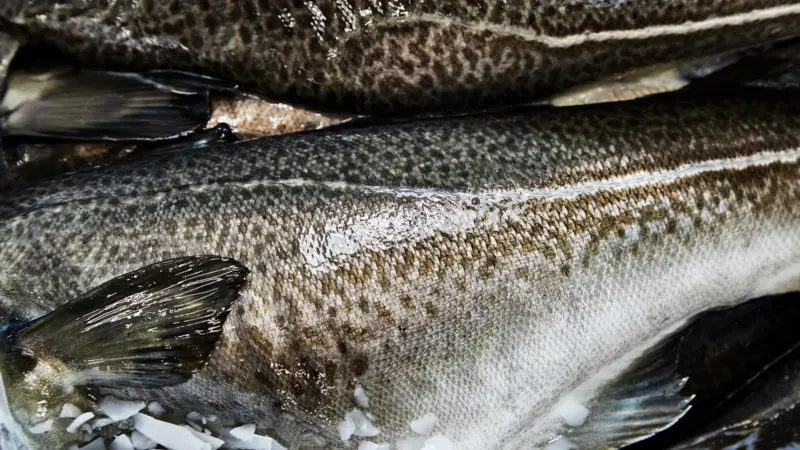
The fish which turned out to be most interesting for World Fishing was coley, even though it did not win. It encapsulates all the issues. Its champion was an impassioned Mike Mitchell, Head of Seafood Sustainability at FoodVest Group (which owns Young’s and Findus).
Readers know there is as much coley (pollachius virens) about as it has names including the unappetising ‘coalfish’ and ‘green’ cod. But UK folk are not buying it. Mike Mitchell wants them to. Also, it turns out Waitrose, the up-market British food chain, has started a campaign for pollachius. A big article in the Independent on Sunday newspaper in January reported: “Meet the fish that could just save the cod…Waitrose is championing coley as the ethical fish of choice for 2008”. Waitrose has pulled in some celebrity chefs to help the campaign along.
At the Billingsgate meeting, that ‘saving cod’ headline rightly came in for some criticism about its validity. Anyway, coley is cod family too and also readers know that 200,000t a year from Iceland alone means there is plenty of regular cod about. It may be more pertinent to ask who is keeping the latter’s price so high. The article said coley would be up to “40 per cent cheaper than cod, selling for £9.99 a kilo compared with £16.99 for the chain’s prime cod fillets”.
Thanks to gale force conditions in Scotland, the meeting was lucky enough to have skipper Peter Bruce in the room. His “Budding Rose” (PD418) could not put to sea so he had come down from Peterhead with James West, patriarch of the West family in the Trawlermen TV series.
There were questions during discussion time about supermarkets controlling price, supply and demand. Mike Mitchell had said it was unfortunate that during the Trawlermen TV programmes clear disappointment could be heard from the trawlermen when mainly coley poured on to the deck.
This was the cue for Peter Bruce to point out to the meeting that this was because the fishermen were only being offered 50 pence (£0.5) per kilo for their coley.
At that price even consumers must realise fishermen could not afford to catch it and live. Waitrose staff (part of the employee-owned John Lewis chain) have just had a 20 per cent bonus share in profits, equivalent to 2.5 months of salary. One might ask what they understand by the word sustainable in terms of livelihood when contrasting £0.5 per kilo against the sale price of £9.99 a kilo. Waitrose’s own website proclaims that it was named Top of Sustainable Seafood Supermarket League Table in 2007 by the Marine Conservation Society (MSC), and Seafood Multiple Retailer of the Year 2007 by SEAFISH.
Luckily for Waitrose it was not one of the 10 supermarket chains, named in a report by ITN News in February, which cleared their shelves of batches of, allegedly diesel-contaminated, salmon which had been delivered by Marine Harvest.
One might also ask whether there is a link between discards and such low catch prices for coley and other unregarded species. Might that reflect on the sustainability awarders and supermarkets who claim they are leading the way on sustainable catch?
Abundant langoustines from Scotland are earning good money and Scottish fishermen seek them out. When trawling was criticised at Billingsgate, a bashful Peter West took the mike and told the audience that seabed trawling seemed to be having a direct, beneficial effect on langoustine availability. As they had trawled the same areas regularly over the last few years, so had the langoustine increased in numbers, he said. This seems to back the Faroese trawl data on catch increases, reported before by WF. It was interesting to see the effect of an experienced fisherman quietly telling a skeptical audience something which they were just not aware of.
Plethoracraticus
WF asked the MSC speaker whether it was not time for all the various NGO bodies, who were setting themselves up as certifiers or quasi regulators and inspectors of one kind or another, to wither away and be replaced by a properly funded, independent body. This would have no agenda except the consumers’ and the producers’ quality standards. Another linked question was for an explanation as to exactly what was behind the NGO MSC’s connection with a World Wild Life (WWF) campaign on ‘stinky fish’.
It was pointed out that there were already national public health bodies worldwide which collaborate on standards and surveillance, so why keep adding more. Further, WF suggested, there was a model of a clearly funded, totally independent, scientific and enforcing agent sitting in the room and chairing the meeting – Chris Leftwich, Chief Inspector of the Worshipful Company of Fishmongers. His formal, overarching powers go back to the 13th century.
The responses from the MSC speaker failed to reassure not just WF but others at the meeting. Later WF was buttonholed by an MSC PR person. WF could only point out it was unhappy with the answers because it always tried to get objective, neutral data whether from government, the industry, fishermen or NGOs.
Charlie Caisey MBE has been in the fishmongering business for 56 years. Apart from his activities for the National Federation of Fishmongers he also leads courses for budding fishmongers at the Billingsgate School.
He told WF that he was no fan of the supermarket chains because of the way they have hit local fishmongers. He also finds the plethora of different bodies, making their living from the hard work of fishermen and fishmongers, quite unsettling.
He believes quality at catch and the point of sale, and not a host of certificates, is what produces loyal customers who trust the fishmonger to have done her or his work on sourcing from honest fishermen.
“How do you get the best?” Charlie asked. “This is the only way I know – there are two young ladies here [at the Billingsgate 2008 award meeting] who I introduced to the fish business and one is very successful and this one is about to start. I walk round the market and I show ’em quality fish and I also say you’re saying [to your customer] exactly where we come from”.
He echoed Leftwich (see below) about the amount of time wasted by bureaucracy which adds little to hygiene or quality. Charlie said he always knew exactly what his premises needed. “I didn’t want someone else to tell me. Think about the man with a leasehold shop – is he going to spend £10,000 or £100,000 pounds to get a piece of paper? When you already know you are a good fishmonger – you don’t need this!” Efforts by the likes of Charlie and the School to bring on younger fishmongers may be an important part of closing the middlemen gap.
Should one need to certify Craster kippers, for example, when they are already a benchmark standard through their reputation developed over decades. Certification is expensive, and now a big business in its own right, and a major cost except for the big chains whose primary aim is probably using it to corner market share. The MSC told the meeting about certification of an operation of five fishermen who are catching around 7,000 seabass a year on 40 miles of the Flamborough Head shoreline between tides, using gillnets and quad bikes.
Later, WF was told by MSC that it cost £20,000 (20k sterling) to pay the consultant to do the certification. MSC then added that in fact the fishermen did not have to pay. The cost, WF was told by MSC, was covered by the UK Department for Environment, Food and Rural Affairs (DEFRA).
DEFRA is a ministry funded by taxes from the UK public. A few years back DEFRA was criticised by the EU veterinary authorities for taking far too long in processing public health food (including fish) toxicity test samples. At the start of this year DEFRA was facing fines of up to £500 million by Brussels for taking too long to pay UK farmers their rightful support funds and putting them at risk of bankruptcy…and suicide. The EU fines will come out taxpayers’ money.
Common sense
Sustainability therefore, may best spring from common sense based on available catch and quality at the roots, not certificates flown like a kite. Chris Leftwich’s line on fish quality control goes to the heart of this debate. “Fish are going to tell you when they’re off – it’s as simple as that. With your eyes, your nose, your touch… with a modicum of common sense and training you are going to be able to determine good or bad quality”. (WF September 2006).
Quality means good, old-fashioned hygiene – making sure people wash their hands and preserve the cold chain. “The bad news, he says, is that on-the-ground inspection is being sacrificed on the slab of bureaucracy”. Not just fishermen but teachers, doctors and inspectors, he suggests, are swamped with bureaucracy, producing statistics for bodies such as the Food Standards’ Agency. Computerisation has not eased but increased the bureaucracy, he adds.
Seasonality and local supplies also crept into the Billingsgate debate. It is common sense that fish caught in season are at their best, and fishermen will create loyal customers if they can shorten the route for seasonals from catch to plate.
But seasonality does not suit processors and supermarket chains. They want all year round sales slotted neatly into their own special offers for price planning months ahead. It does not fit their logistics, by size, pack, pallet and truck. Yet fresh is perhaps only more costly because it cannot fight the deciding power of the pre-packaged chains. There could be some red faces if there were a survey of the energy cost and ‘carbon footprint’ of storing processed and packaged, chilled and frozen food in warehouses for months. Not forgetting further months of electricity in the home freezer.
And finally, la gallinette from Marseille, she who carried off the 2008 award. Her classic name is aspitrigla cuculus (and also helidonichthys lucerna). She is misnamed as a ‘flying’ fish because those wings are in fact her ‘finlegs’ which she uses to walk on the seabed. It is not clear whether she was trawled or sustainably hooked.
Under her English name of gurnard, she was the sustainable choice of Mike Berthet, a director of M&J Seafood. He gave a classic lesson on how to take an unknown fish and, with the right theatricals, persuade people to like it. WF need only recall our earlier reports from France of how fishermen, local restaurateurs and fishmongers took an ugly fish call rattail and turned it into a best seller called grenadier.
An empty, mini ER trolley, decked with a white cloth was wheeled on while he Mike praised his gallinette. After a teasing gap, his knife-wielding colleague appeared in a white coat to bring his blade down on la gallinette. We were told she was difficult to gut and bone but we would be shown the easiest way.
Sitting next to WF was expert and regular gutter of la gallinette chef Jacques Dupont from Boulogne. He winked and said: “It is so easy”. But this was theatre, and, after head and backbone were finally held aloft before the assembled crowd, the conjuring trick was done and the applause rolled in. La gallinette was served to all at lunch and won a majority of palates.