



Menakhem Ben-Yami looks at various technologies awaiting commercial implementation.
Many innovations are waiting for commercial application, but it seems that the innovators also need a bit of luck and exposure before they find potential clients/users for their inventions.
Innovations that are inexpensive to introduce and soon bring evident benefits have the best chance of fast implementation. Here are some, still in waiting, I have come across.
Robot fish cages
While several types of offshore fish cage farms have been in commercial operation for some years, efforts continue to develop floating fish farms that are able to survive in the hostile conditions of the open sea. One such design, developed and experimentally tested by MIT is a Self Propelling Fish Farm Prototype. The vision is of a huge ‘thinking’ fish cage able to navigate itself to optimal locations and submerge when exposed to rough weather. Even though it is still in embryonic stages, most of the technology for automatic fish farms drifting in the open sea is already available.
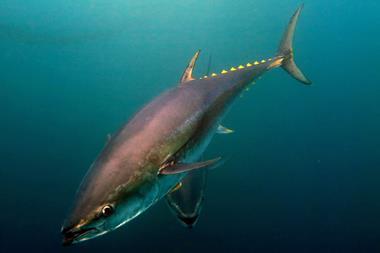
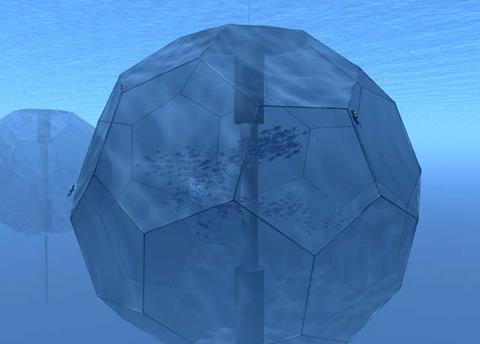
A commercial company, Hawaii Oceanic Technology Inc. has recently announced that it intends to deploy a huge automated spherical fish cage designed to float freely in the depth of the ocean, dedicated to the outgrowth of large tuna species. This 60m diameter highly automated spherical fish cage is in its final stages of design and planned to be deployed in about a year’s time. It is hoped to be capable of holding 1,000 tons of fish at a depth of about 20m below the surface. According to the company, fish would grow faster under deep ocean conditions have fewer parasites and better food conversion ratios.
The company received its final permit from the Army Corps of Engineers last year in a plan to build up to 12 of the spheres in a 247 acre area about three miles offshore, under a 35 year lease from the state of Hawaii.
Tailoring a net body
A quite different innovation, which is still ‘in waiting’ for its application in commercial fishing is a new way of shape-cutting of sections of the body (baitings and belly) of a trawl net, suggested by an Israeli-Russian fisherman and fishing technologist, Leonid Simkin.
According to Simkin, there are several advantages to his design, some of them being modular construction of the trawl net body, which can be adapted to the trawler's towing power by adding or removing lines of standard sections, and less drag, which enables using thinner twines and thus reducing water resistance by some 10%-15%. Comparative trawlings, accompanied by underwater photography, have shown that the experimental construction spreads the pull in the net more evenly over the netting, so that meshes are open evenly and lines of strain in the netting, which cause distortion of the meshes' shape and reduce filtration, are practically eliminated. Keeping onboard supply of spare pre-tailored relatively small net-sections, should make repairs at sea easier.
Shenker's rotors
According to South African engineer, Maurice Shenker,contemporary trawl boards, however sophisticated, are becoming over age, and should be replaced by remotely-controlled active trawl-spreading devices that can be flown above but close to the sea bottom, as well as in midwater. Shenker developed his Variable Thrust Vector Doors (VTVDs) idea in the 1990s, but it's still ‘in waiting’ for a serious commercial proposition.
Commercial deployment of the trawl-spreading rotors has been faced with the usual deterrents, such as the higher initial investment than for conventional doors, and the mental reluctance towards introduction of a strange novelty in a crucial location in the trawl gear.
This is in spite of the potential benefits due to improved and more efficient hydrodynamic performance, smaller power requirements and lower fuel consumption, as well as the fact that it is specifically engineered for non-contact bottom trawling. Using all sorts of data and information from the bridge monitoring instruments, it precisely controls the gear position in water, maintains optimum net spread, and all this at a variable automation level.
The Magnus Effect, which is the perpendicular force exerted on a spinning body moving through a fluid stream, is employed in the rotor devices used in the VTVDs of the Active Trawl System. It achieves both horizontal and vertical control with the same device, and offers benefits and functionality not achievable with other methods; it incorporates cableless control and monitoring of the rotors, unlimited trawling time endurance, very fast response, 360° operation, lift infinitely variable from zero to maximum, both positive and negative, smaller lighter package for the same lift values, and no need for angle of attack setting.
Shenker believes that all these and other operational innovations will eventually make them a worthwhile financial proposition.
Solar propulsion
It's easy to Google to a plethora of all sorts of actual and dreamt-up small and giant futuristic designs of solar-powered single-hulled and catamaran vessels, some of them evidently in operation. Last January a fishermen from Mangrol Taluka in Gujarat State, India, reported that he was using a new solar fishing boat, which was functioning well and delivering good results, with fishing less expensive comparing to the huge expenses for fuel and engine maintenance of a traditional fishing boat. There was also a marginal increase in the catch; for the solar boat does not generate any sound as conventionally powered, noisy boats do, scaring fish away.
The Indian solar fishing boat is the brainchild of a cooperation between two Indian companies. Solar panels installed on top of solar boats, which convert sunlight into electrical energy also provide shade to fishermen, charge the battery through a charge controller, which both improves the efficiency of power generation and protect the battery life. The charge controllers are designed to ensure that even when sunlight is low, optimum energy will be generated. As in most innovations, the cost of a solar boat is still quite high, however it's hoped that in near future its price will gradually come down. Now, the outboard motor of solar fishing boat is about the total cost of a traditional fishing boat.