



Simrad develops new multibeam eco sounder for fishery research
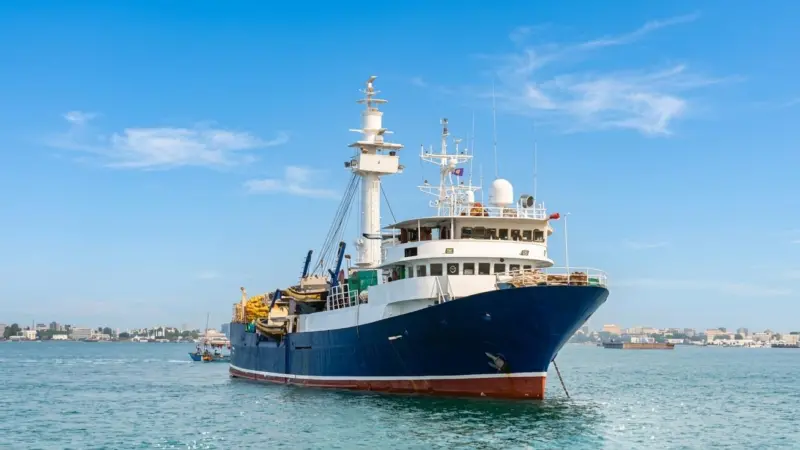
Simrad and IFREMER (French Marine Institute) have developed a new multibeam echo sounder for fishery research purposes. The ME70 is a giant step forward in fish stock assessment technology and is set to become a key factor in the sustainable management of fish resources, according to a statement from Simrad. The first ME70 will be installed onboard the French research vessel, Thalassa and Simrad says that it is also working on a version for the IMR (Norwegian Marine Institute) to install onboard the Norwegian Research vessel GO Sars.
A precise estimate of the abundance of commercial fish resources is essential when setting fish quotas. The new multibeam technology in the Simrad ME70 has several improvements compared to the traditional single beam methodology, enabling more accurate and flexible assessment. The company says that it provides a greatly increased sampling volume, which enables improved input to stock estimate models. The ME70 can also see fish close to the bottom, which before now, was considered a ‘blind zone’ for fishery research.
The ME70 operates in the 70 to 120 kHz frequencies with a configurable acoustic fan containing 3 to 45 stabilised beams. Each beam is from 2° -3° wide depending on operational frequency, with a maximum total swath width of ±45°. Minimum acquisition depth is less than 1m below the surface and maximum acquisition depth is approximately 700m for a ˆ20 dB single target and 800m for a ˆ40 dB volume target.
Simrad says that the system configuration can be tailored to any user requirements allowing for a choice of beam widths and transmission modes. It is possible to set-up continuous output of all beam data for use with echo integration and 3D visualisation, and a real-time display enables quality control of current data acquisition. The ME70 is also configurable for two-way remote control, enabling ‘offsite’ operation.
“ME70 delivers the large and flexible sampling volume of the multibeam swath with the accuracy of a quantitative scientific echo sounder,” says Frank Reier Knudsen, Ph.D, Fishery biologist/Fishery Research at Simrad. “The beam characteristics make it a flexible tool for fish stock assessment in various environments, with sophisticated fishery research vessels such as Thalassa and GO Sars now able to provide even more accurate data. It’s technology such as the ME70 and our recent fish-tagging system that help to ensure that commercial fishing remains a long-term, viable prospect,” concludes Knudsen.
Spanish contracts
In the same line of fisheries research, Simrad will be supplying with navigation and hydroacoustic equipment to the two new Spanish fisheries research vessels that are being built at M Cies shipyards in Vigo, Spain. A statement from the company says that “several reasons including complete integration, similar project references and local support capability factored in Kongsberg and Simrad being chosen for the contract. Additionally, the Secretaria’s previous experience with Simrad, onboard the R/V Vizconde de Eza (another Spanish research vessel) played a large part in the choice of the extensive package.”
The new research vessels will carry equipment from six Kongsberg Maritime and Simrad departments.
A 27m vessel for coastal continental shelf studies (ESPACE project) will be delivered at the end of 2005 and will be equipped with:
* Scientific Equipment with Kongsberg Maritime EM3002 D multibeam echosounder, Kongsberg Maritime Hydrographic Echosounder EA600, TOPAS PS40, Kongsberg Seatex Seapath 200, sound velocity sensors and dGPS receivers.
* Simrad Fishery Sonar SH40, EK60 Multifrequency Echosounder, Net Sounder ITI.
* Bridge navigation from Simrad including autopilot, radar, gyro, electronic chart system and communications.
The largest vessel, a 70m multipurpose vessel due for delivery at the end of 2006, will conduct full ocean research operation.
In addition to the supply of navigation and scientific equipment, the contract also covers the full commissioning and training for both vessels.
Simrad Spain SL has a history in supplying navigation and scientific equipment to Spanish research vessels. Since 1997, the company has supplied both Kongsberg Maritime and Simrad equipment to R/V Hespérides for the High Research Council (CSIC), R/V Vizconde de Eza for fishery research, R/V Cornide de Saavedra and R/V Fco. de Paula Navarro for Oceanographic Institute, and H/V Tofiño, H/L Astrolabio and H/L Escandallo for Navy Hydrographic Institute.
Related Articles
 FISHING TECHNOLOGY
 FISHING TECHNOLOGY
 COMMENT