



Salmon fishing and a traumatic tale
Menakhem Ben-Yami reviews two very different fishing books.
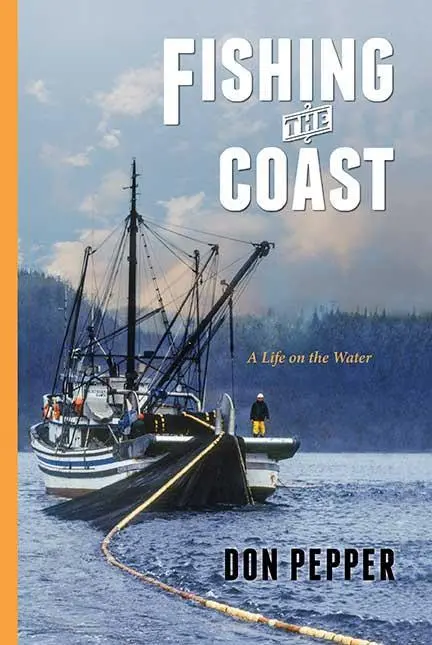
The author*, a doctor in economics, fished salmon on the coast of British Columbia on and off for 50 years. He saw salmon-seining technology development since 1953, from table seiners with aft-mounted powered rollers, through Puretic power blocks, to the modern drum seiners, and from cotton, manila, and sisal twine to synthetic fibres. He also describes in detail the design and assembly of salmon and herring seines. With the exception of skippering, Don had done every single job onboard drag-seining and gillnetting boats: skiff-man, beach-man, cook, and engineer.
This book, well-illustrated in maps, drawings, and old photos of boats, gear and actions, is a chronicle mainly of salmon fishery development in BC’s mostly protected inshore waters, on their plethora of ethnic participants. Much of it happened during WW2, which much influenced the area’s fishery economics by stimulating fishing and fleet development. The boom years came to an end towards the 1970s, when the fleet over-capacity and decreasing catches started affecting BC’s fishing industry.
Don had fished all five species of BC salmon: sockeye, pink, coho, chum, and spring or king salmon, each with different market value, different behavioural characteristics and, accordingly, required different fishing approach. His book captures the fishing life and practice of an era now past. He writes: “…fishermen starting out today may find only a little here they recognize and can use; old-time fishermen may have their memory refreshed and appreciation of how we did it and why.”
Nevertheless, since the author describes in great detail the technique and tactic of fishing the different salmon species, from fishing in Adams River for sockeye to illegal herring fishing with light-attraction, as well as the old fish processing techniques, and documents a whale of knowledge and experience, I doubt whether all fishermen reading this book would agree with him that “only a little” of it could be useful. Aficionados of fishing lore will find stories on various adventures and crew’s foc’sle life.
Some of it could be his description of tides fishing in connection with specific fishing grounds, such as for example, Double Bay and Blinkhorn, with the fishing good at flood tide in one site and at ebb tide, in the other. Some of it is a true history, as his recalling the late 1990s ‘US-Canada fish war’, or the practice of the past of home canning of the salmon, when groups of women acquired hand-cranked canning machines, packed the fish, and then boiled the cans on big bonfires. Salmon was also smoked in small cedar-shake smokehouses over small smoky fires.
Don believes, and rightly so, in my opinion, that “fishing is not only an occupation, but also an art”. Perhaps even more than that: a way of life and being in love with the sea.
The Night Orion Fell
The book The Night Orion Fell**is a story about a traumatic accident which one has to be a marine fisherman to fully believe and fully visualise. The author, Abigail Calkin, herself a New-Englander, is a professional writer with seafaring roots, who now lives and writes in Alaska.
It takes a very good writer indeed to describe in such agonising suspense the horrible hours during which skipper of F/V Fargo, Larry Hills, struggled – physically and psychologically – to survive against all odds one of the strangest accidents I heard and read about in my working time and later – and there were lots.
Her narrative takes the reader to the harrowing moment when Dick, the 27-year old deckhand, first got caught in the warp coils that pinned him to the revolving trawler’s net-drum, then Larry (32), the skipper, whose hands got trapped as well, when rushing to Dick’s rescue. The hydraulic net-drum kept revolving, taking the two fishermen round and round and coiling them with more and more coils of the warps until, fortunately, the oncoming trawl net slipped over the reel’s flange and jammed the machine.
That was how a 40 hour long ordeal, during which Dick died, started. Abigail has skilfully described in harrowing detail how Larry managed to survive in cold stormy weather, with both his hands pinned to the net-reel. Just. Then she takes the reader to the rescue efforts and to finding the Fargo by a Coast Guard aircraft, the bravery of the people lowered in ware and on the deck of the rocking and rolling vessel, liberate the gravely hurt Larry, and lift him safely to the hovering CG helicopter.
The last parts of the book tell the story of Larry’s painful and prolonged hospitalisation and convalescence and his rehabilitation from disability. Larry Hills, couldn’t return to sea, but found a new challenge in working in southeastern Oregon for the US Forest Service.
This mind-boggling account of survival and bravery should also serve as a warning to fishermen that everything that can go wrong onboard, however improbable, may eventually go wrong, and a reminder to us that with courage and spirit, humans can survive even the worst dangers and apparently hopeless situations.
Compliments to Ms Calkin for this brilliant account of Larry Hills’ and his rescuer’s saga. This book should become obligatory reading to every marine fisherman.
* Don Pepper, 2013, Fishing the Coast: a Life on the Water, www.harbourpublishing.com