



Safety in US fisheries on an upward trend
Last January, the US Coast Guard (USCG) published the fifth edition of its fishing vessel casualty study, U. S. Coast Guard, Office of Investigations and Analysis: A review of lost fishing vessels & crew fatalities, 1992 – 2010. Menakhem Ben-Yami looks into its findings.
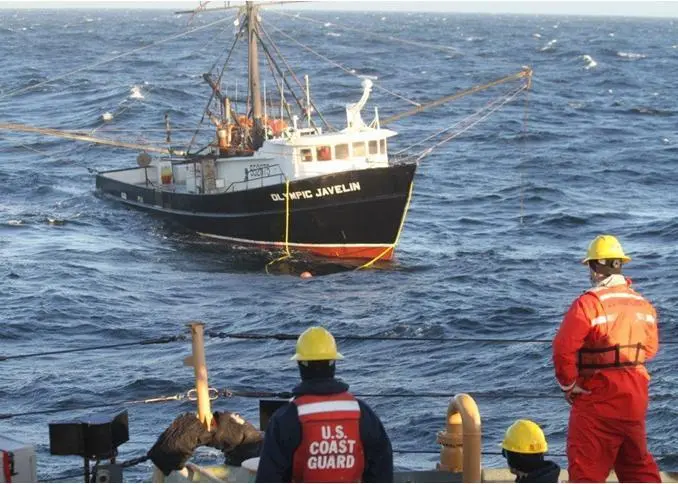
A detailed analysis of trends in the incidence of fishing vessels in emergency, loss and crew fatalities, this report covers factors such as: location and operation of the vessel at the time of the incident; availability and use of lifesaving equipment; the causes of the loss of vessels and people; cases of assistance given by non USCG vessels, and, participation of fishing vessels in the voluntary programme for improving seaworthiness and safety at sea.
The USCG is one of the five US military services and until 1798 it was the only naval force of the fledgling USA. While it operates under the Department of Homeland Security, in time of war the USCG can be put under the command of the US Navy. Its duties comprise maritime safety and law enforcement, and preventing terror activity and hostile infiltration in both domestic and international waters, as well as preventing marine smuggling into the USA. It has been often employed to react to hurricanes and oil spills, operates icebreakers in oceans and the Great Lakes, and monitors and reports all polluting discharges anywhere into the sea. USCG is the seaborne and airborne service, in charge of marine search-and-rescue (SAR) – one of its best known missions. Thus, the USCG is constantly involved in commercial and recreational fisheries by supervising and enforcing their seaworthiness and fishery laws, and saving lives and vessels. In the USA, unlike most other countries, there is no special SAR dedicated service.
For the 19-year period from 1992-2010, 2,072 fishing vessels were lost at sea, and 1,055 fishermen died off the USA coasts. Over half of the casualties occurred at the same time a vessel was lost, which was 38% of the total vessels lost. Although the inert statistical data indicates an annual average of 109 lost vessels and 56 fatalities, while making way through the multitude of graphs and tables the report is loaded with, one finds a distinct trend. It appears that while between 1992 and 2002 the number of fishing vessels sunk, grounded or otherwise lost, ranged between 166 and 122, between 2008 and 2010 it decreased to 55-57.
It seems that the study understates the USCG’s role in this trend, while stating that “the drop is most likely due to a combination of economic, environmental, fisheries management and other regulatory factors”. Notwithstanding, it observes that after the terrorist attacks of 11 September 2001, the presence of USCG ships and aircraft along the US coast increased by a large percentage. This has improved fishing vessel safety through deterrence owing to the increased number of fishing vessel boardings at sea and, with the increased number of patrolling ships and aircraft, reduced the time of responses to emergencies.
The USCG on an average day, apart from all its other duties, saves 12 lives, responds to 64 SAR cases, and boards 13 fishing boats to ensure compliance with laws. It explains the reduction of vessel losses also by increased emphasis on fishing vessel safety and safety equipment during at-sea boardings, additional training for boarding officers and stepped up outreach activities.
Survival suits
To analyse the incidents’ causality, the USCG examined in detail the information available apart from the statistical data. It appears that most incidents were not directly related to fishing operations, but mainly to cruising to or from port. Bad weather and rough seas are often factors. Most of the fishermen who found themselves in water drowned or succumbed to hypothermia, after their boat had sunk or capsized or after they fell overboard. Along the West and Northeast coasts, where the water is coldest and most of the exposure deaths occurred, whenever fishermen properly used survival suits, their chance to survive doubled. Unfortunately, the use of survival suits was infrequent in those events. Thus, water exposure was, by far, the most significant factor – 77% of all fatalities. Accordingly, the rate of fishermen’s death has been the lowest in the warmer waters of the Gulf of Mexico and along the Southeast US coast.
Unfortunately, the USCG has only limited authority over fishing vessel design and maintenance. Training in marine safety and onboard examination of seaworthiness are voluntary, and the smaller vessels can be commanded by non-certified skippers. Notwithstanding, Federal Regulations prescribe the safety equipment fishing vessels must carry. One of the report’s findings was that when vessels had, and fishermen used the equipment properly, their chances of survival increased significantly.
Fishing boats may tip or sink due to bad weather and rough seas, flooding, fire, improper loading, mechanical problems, poor maintenance, poor design or a navigational error. Falls overboard may result from a wave, a mis-step, a slippery boat deck, entanglement in fishing equipment during gear setting, and drunkenness. Missing or faulty safety equipment was another factor contributing to fatalities. It appears that the presence and quick help from other craft in the area (nicknamed Good Samaritans) have prevented a significant number of human fatalities in 30% of cases when vessels were lost.
Hundreds of fishing people and many, many others owe their lives and vessels to the USCG skippers, pilots, swimmers and the rest of the rank. The USCG is outstanding among the world’s armed forces in being dedicated to saving lives rather than taking lives.
The report can be viewed at http://www.fishsafe.info/FVStudy_92_10.pdf
Related Articles
 FISHERIES
 FISHING TECHNOLOGY
 FISHING TECHNOLOGY