


Positive signs in campaign to reduce ocean litter
Good progress is being made in reducing the amount of ocean litter caused by the marine industry, including the commercial fishing industry, writes Bryan Gibson.
Wikipedia states that an estimated 10,000 containers are lost at sea by container ships each year. A famous spillage occurred in the Pacific Ocean in 1992, when thousands of rubber ducks and other toys fell overboard during a storm. The toys are still being found all over the world and providing a better understanding of ocean currents. Similar incidents, such as the Hansa Carrier, dropped 21 containers.
In 2007, MSC Napoli was beached in the English Channel, dropping hundreds of containers, which held motorcycles and components, most of which washed up onto the Jurassic Coast on the English Channel coast of southern England, a World Heritage Site.
On the remote sub-Antarctic island of South Georgia, fishing-related debris consists of approximately 80% plastics, which are responsible for the entanglement of large numbers of Antarctic fur seals. Marine litter is even found on the floor of the Arctic Ocean.
Recently established environmental protection organisation The Think Beyond Plastic Innovation Forum is inviting innovators and entrepreneurs to seek resolutions which can measurably reduce environmental plastic pollution. The forum is searching for innovators in recycling, material manufacturing and design, which can lead to a measurable reduction of plastic pollution.
The rest of the world is slowly beginning to recognise the long-term effects sea pollution has on the species they depend on for their living. Chemical pollution and the highly poisonous nature of discarded plastics slowly degrade into biology-damaging micro-particles as they sink onto the deep ocean floor. They gradually erode into ever smaller and numerous pieces by the action of the sea and become accidentally consumed at every level, down to ‘the soup of life’…plankton. Plankton are eaten by almost all smaller fish, and small fish are eaten by bigger fish, so the same poisons restart a journey, but on this occasion, all the way back up several food chains. In theory, raw plastic pellets (nurdles), can continue being consumed by animals forever.
Even though waste may not have been dumped directly from a boat, an unhealthy quantity of ocean-polluting material usually ends up in the sea at the expense of the marine environment. The law of nature decrees that all water, whether crystal-clear or polluted, will find its way into the sea, whether such material is diverted to landfill, incinerated or cleaned-up via a water-based process.
When whales, sharks, seals, turtles and other prey hunting species such as dolphins become entangled they often suffer a slow death due to starvation by being prevented from diving to catch food.
Fishing for Litter
In a concerted effort to reduce the massive quantity of floating and the estimated sunken litter inhabiting UK’s fishing grounds, the Fishing For Litter scheme was introduced in 2005 by the international environmental organisation Kommunenes Internasjonale Miljøorganisasjon (KIMO).
KIMO was founded by municipalities with a shared concern for the state of the environment after a series of emerging environmental threats became the catalysts for its foundation, which are expected to remain long into the 21st century. KIMO is also designed to give municipalities a political voice at international level and to share best industry practice, and to search for solutions to the political problems, which can impact badly upon remote coastal communities.
KIMO is now a pioneering environmental force, which has contributed to a steady reduction in marine pollution within Europe’s seas and believes momentum must be vigorously sustained. An estimated 20,000 tonnes of litter is dumped into the North Sea every year, and many millions of tonnes worldwide.
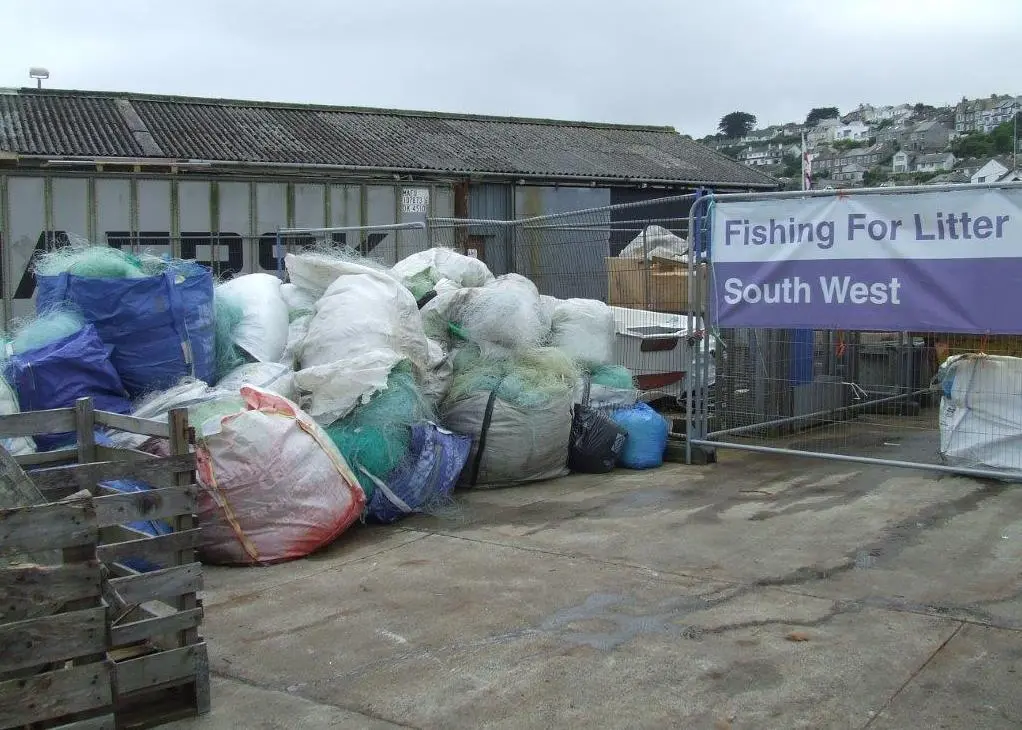
In an effort to reduce the problem, Fishing for Litter was conceived by KIMO as an imaginative and simple initiative to reduce marine litter and to raise awareness of its existence at commercial harbours and to directly involve professional fishermen. KIMO provided fishing boats with large bags to deposit marine sourced litter. When full, the bags are deposited on the quayside to be collected and environmentally disposed of.
The Fishing For Litter commercial fishing harbours campaign, funded in UK by The Crown Estate, has succeeded in noticeably reducing the volume of debris being washed up onto beaches, as well as the time fishermen spend removing ropes and untangling nets from their propellers.
The Fishing For Litter scheme originated in the Netherlands, spread throughout Scandinavia, and became popular in Scotland and the isles, and finally Cornwall in England, where it became noticed by the county’s many tourists, who love quaint fishing villages.
Padstow’s Harbour Master and Port Administrator, Captain Rob Atkinson, told WF&A, “Although we only have two large fishing vessels based at Padstow, the crews recognise the importance of removing dangerous discarded fishing materials from their workplace, and we, as Harbour Authority, have given our full support by providing collection bags, free space on the dockside, and a phone call every couple of months to Cory Environmental Services [the local authority waste contractor].
The Fishing For Litter initiative not only involves direct removal of litter from the sea, but the campaign also raises awareness of the significance of the problem amongst communities, young and old. Plymouth, UK, City Council has also launched a new reward scheme for youngsters observed to be responsibly disposing of drinks containers and fast food packaging in the town centre.
Further reading
‘The deep sea is a major sink for microplastic debris’, Dec 2014: http:/ /rsos.royalsocietypublishing.org/content/1/4/140317.abstract
EcoKids Program: http://www.ecokids.ca/pub/eco_info/topics/oceans/risks_to_oceans.cfm