


Pirates, poachers or global crime syndicates?
First the bad news, from the 3rd Update and Stakeholder Consultation on illegal, unregulated and unreported fishing (IUU) organised in London by the Royal Institute of International Affairs. Stakeholders conspicuous by their absence were fishermen, with not one attending. The agenda and meeting was dominated by officials, academics and non-governmental organisations (NGOs).
Over the two days, World Fishing pointed out the ghost of the Mariner absent from the table. Even when a panel was pressed about the role which honest fishermen could play in helping monitor the pirates on the sea, not one of the panelists even responded to the specific question.
An honest apology from the organisers was forthcoming and they promised to try to rectify the glaring gap next year. They cordially invited fishermen to attend the 2008 conference and individuals and organisations can sign up for the IUU e-newsletter – see: http://www.illegal-fishing.info/signup_basic.php
It is clear that the army of monitoring people making a good living on the backs of the fishermen have serious intent. However, the crime syndicate scenario painted by the IMO’s security chief, raises questions about where the best focus should be. WF has been reporting about pirate fishing for decades. It explored the European Parliament’s detailed investigation into piracy over Patagonian toothfish in the mid 1990s. That it has taken so long for toothfish to become such a focal issue for NGOs today may indicate that it is fashionable eco issues which are the driving force behind NGO interest in toothfish and the wider IUU area, and not the losses caused to honest fishermen.
The data issue raised its ugly head again. There were lots of computer models (often using recycled data) including an intriguing version to evaluate the honesty of fishermen…The representative of one commercial company at the meeting summed up the attitude of several participants when he casually described fishermen as people who went everywhere, took everything and then disappeared.
While EU Council President Horst Seehofer insisted to WF at Mainz (see WF July 2007, “Three men in a boat”) that the “official”, guesstimated IUU figure is 30 per cent of the global catch, the meeting heard estimates up to 40 per cent. If we assume IUU costs at least $2 billion, then the difference between the overall percentage guesstimates means a lobster pot of $500 million dollars has gone adrift. That kind of cash could cover a large volume of socioeconomic measures. Alas, none of these monitors can really give us the true extent of illegal fishing – that, of course, is the nature of the beast.
Land crime syndicates
A fight back against piracy and organised crime is certainly on the way for West Africa’s ports and EEZs. The IMO’s security division has coaxed two dozen West African states into an innovative alliance linking coastguards with Interpol, FAO, UNHCR, navies, insurers and other ‘action’ partners.
IMO maritime security chief, Chris Trelawny, told the gathering that a range of action plans were slated for clearance in July by ministers of the 25-country Maritime Organisation for West and Central Africa (MOWCA).
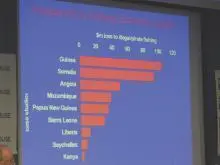
Trelawny says one way of funding severe underinvestment in port and sea surveillance is by tightening the net around IUU. He said Guinea, Sierra Leone and Liberia alone were losing some $140 million a year and Sub-Saharan Africa loses up to an estimated $1 billion.
Trelawny said IMO’s normal remit was energy security (of tankers and port installations) combating piracy, ensuring safety at sea, vessel seaworthiness and port security. But officials at a recent IMO-MOWCA meeting in Accra had agreed they could combine general security with action against the illegal fishing crime syndicates. The way ahead was an easy-to-start “multi-agency approach through the three buzzwords of coordination, cooperation and communication”, Trelawny said.
Piracy and IUU, off Nigeria for example, were not just a “bit of poaching but armed robbery,” he said. The need was to tackle a long tentacle of organised crime with global links running through transhipment at sea, ports, container depots and into the land supply chains.
Trelawny said there was an important role for the UN’s Office on Drugs and Crime, and the UN High Commissioner for Refugees (on illegal migration). Involving Interpol could help track crime networks, from illegal fish and drugs to human trafficking and counterfeit goods, in pursuit of the big men behind the rackets.
But too many countries did not have the money for fuel, never mind the hardware, to run adequate surveillance at sea or port security. The new plans include training by Britain’s Royal Navy, which like the US navy, is interested in energy security in the Gulf of Guinea. “We are not trying to raid the fishing industry – just saying that if you run it properly it will provide you extra revenue which you can then use,” Trelawny said.
“This is our Integrated Coastguard Network Function (ICNF). We don’t care who does it. We don’t care if it is the navy, we don’t care if it’s the army in a couple of canoes – so long as somebody is doing it,” he said.
Transport and fisheries ministers often had no access to their navy. One plan was to mobilise navy vessels which could work as ‘buses’, doing their ‘navy business’ but carrying fishery inspection staff to board suspects. With the right legal agreements surveillance vessels could help by operating in one another’s zones. The ICNF and navy vessels would have access to registry data from IMO, FAO and regional fisheries organisations, and benefit from electronic tracking (radar, satellite and growing real-time Internet connectivity) on all kinds of legal vessels.
The insurance sector could help with measures which reduce theft, smuggling and illegal migration in ports. Further, analysts say owners could lose their fleet insurance if reefers are involved in illegal activities. They might face more time-consuming port controls and blacklists, which will be covered in Part 2 of this article next month.