
Offshore fish farming needs a ‘social’ licence’ to keep growing
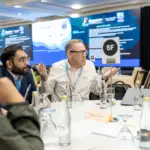
More than 100 delegates from Europe, the Middle East, the Americas and Australasia, met to discuss how to keep their industry growing, in the face of the technological challenges of working offshore, and potential clashes with other users of the maritime coastal estate.
The conference was organised by Mercator Media and supported by the European Aquaculture Society, Spanish Association of Marine Fish Farmers (APROMAR), the Society for Underwater Technology. It was promoted by the Spanish Ministry for the Environment, Rural and Maritime Affairs who provided English-Spanish translation.
The target for growth in all aquaculture was set by the FAO World Aquaculture Report 2006, as growing from current production level of 45.5 million tonnes a year, to 80-90 million tonnes a year by 2030. This growth target would maintain aquaculture’s 50% contribution to meeting the world’s total requirements.
Advantages of offshore
Offshore fish farming advantages over inshore or onshore farming were stated as:
• Better fish flesh quality because of the action of waves and tide on the growing fish
• Reduced diseases and use of antibiotics because of a more ‘natural’ marine environment
• A smaller environmental impact due to a changing column of water around the cages
• The economic advantages of scale which could be huge compared to inshore and onshore farming, because of the available space at sea
Actions needed
The conference supported the 2007 Offshore Aquaculture Technology Platform (OATP) Report which could be summarised as:
• Gather public and consumer support for the health benefits of offshore fish farming – a ‘social licence’
• Harmonise spatial planning and licensing procedure to ensure a balanced use of the marine estate
• Improve environmental and health controls
• Continue technological innovation to increase cage sizes and remote feeding and operations
• Impose legislation to improve operator safety
Experiences in the field
Two Spanish Conference presentations – one which included a site visit – were on mature fish farms on the Mediterranean coast. The first from a regionally-financed farm, Confradia des Pescadores de Connil de la Frontera, explained how in 2000 the Andalusian Regional Government set up a series of projects to test new offshore farming technologies. After seven years the farm was now viable with 8,000 tonnes annual production of sea bream/sea bass. It had installed Sea Station submersible cages to cope with the extreme weather. The project had benefitted greatly from employing local fishermen whose skills and seamanship were immediately transferrable to the project.
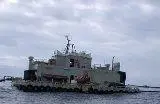
The second presentation from Culmarex SA looked at the lessons from exposed farms, particularly the mooring systems to cope with the Force 10 storms and short, steep seas. Some delegates visited the farm the next day, off the coast at Aquilas, to see the 12 large floating cages and feeder barge. Fabrice Dennis, operations manager, also explained their strategy in purchasing a new, state of the art 250 tonne feeder barge from Gael Force Aqua.
A third Spanish presentation took the audience into the future with PLOCAN, an experimental underwater research facility to be located around the Canary Islands in 50 metres of water. PLOCAN, Platforma Oceanica de Canaries, will be built by 2011 with money from Europe. It will offer a unique test bed for offshore fisheries experiments, as well as other technologies.
Papers from the conference will be available to download from www.offshoremariculture.com