





New mulitbeam sonar for Ifremer
The French Research Institute for Exploration of the Sea (Ifremer) has acquired a second Simrad ME70 scientific multibeam echosounder to strengthen the organisation’s work in the Mediterranean Sea.
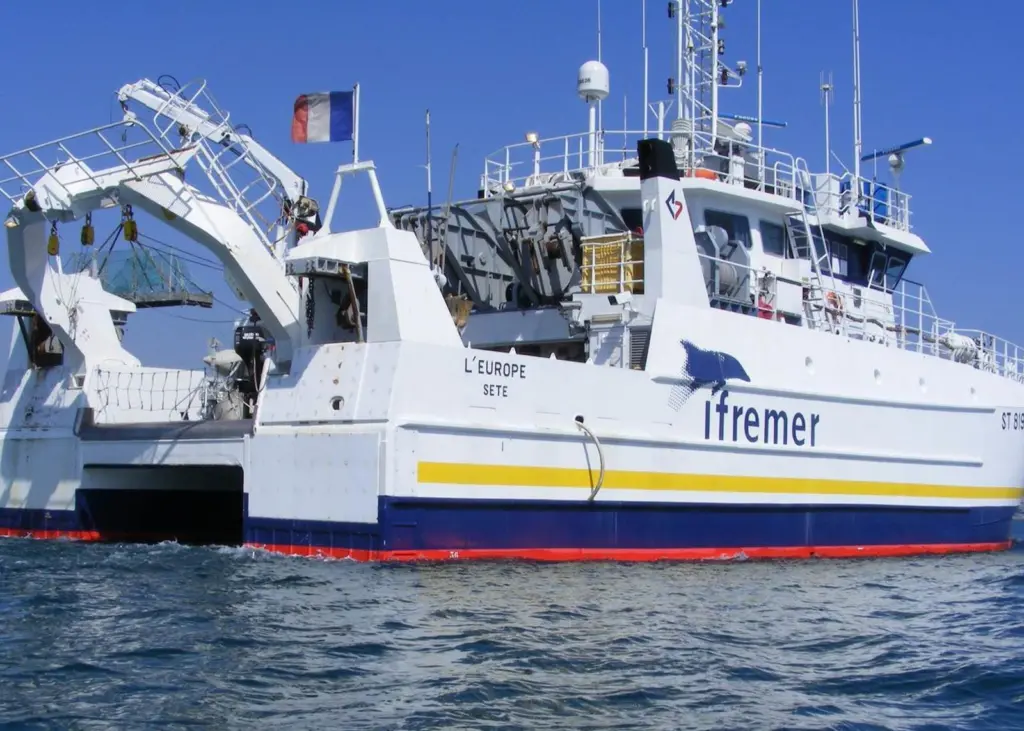
The Simrad ME70 will be delivered as part of the mid-life refit of the L’Europe Research Vessel, prior to planned March 2014 sea trials, and will help Ifremer contribute to the knowledge of oceans and their resources, the monitoring of marine and coastal zones and the sustainable development of maritime activities.
The delivery completes the already installed Simrad EK60 scientific single beam echosounder system to create a ‘standardised’ package that combines quantitative single beam and multibeam systems for vessels that carry out biological surveys. Ifremer has also chosen the ME70 bathymetric module, enabling the ME70 to perform seabed mapping according to international standards while at the same time doing ecosystem surveys of the water column.
“Ifremer was the original driving force behind the ME70, as back in 2003 they awarded us a contract to develop the world’s first quantitative calibrated multibeam echo sounder for their research ship, R/V Thalassa,” says Tonny Algrøy, Global Sales Manager, fishery research at Kongsberg Maritime.
“L’Europe is a relatively small vessel, and in cases like this where only one multibeam system for various reasons can be installed, the ME70 is the only available multibeam system that can both collect quantitative data from the water column and bathymetry data from the bottom simultaneously.”
“The ME70 has added another dimension to our biological surveys on board the R/V Thalassa as it addresses some of the physical shortcomings of quantitative single beam echo sounders such as low resolution and sampling volume,” said Laurent Berger, fishery acoustician at Ifremer.
“It has been many years since we started using the ME70 on Thalassa, but we have now come to a point where we standardise the combination of quantitative multibeam and multifrequency single beam systems on board our vessels that carry out biological survey and research.”
Related Articles
 FISHING TECHNOLOGY
 FISHING TECHNOLOGY
 COMMENT