


While it’s true the European eel (Anguilla anguilla) has significantly declined in numbers, it’s wrong to say this centuries-old delicacy has been overfished. In fact from February this year eel buyers will have the opportunity to buy sustainable eel products that have been independently third-party certified.
Championed by the Sustainable Eel Group (SEG) – a Europe-wide group of scientists, policymakers, environmentalists and commercial operations – the Sustainable Eel Standard (SES) is an independent, piloted and tested sustainability eco-label that was created to take the unique biological cycle of the European eel into account.
Under the eel eco-label, independent assessors will review to what extent a business complies with strict criteria. Each will score as a red (fail), amber (passes a minimum standard) or green (passes a high standard). A majority of green ratings are required to pass the standard and any reds will result in an overall fail.
SEG chairman Andrew Kerr said the group believes that a well regulated fishery meeting the standard, which has taken three years to develop, is as important to the future of the eel as direct conservation and habitat programmes.
“We fear that if mankind does not value the fish then it will disappear like the sturgeon; the slimy eel is no panda or tiger so it will not be looked after for its own sake,” he said.
WF&A readers should note the SEG was formed in December 2009 to help rebuild stocks and to back the European Union’s Eel Recovery Regulation (1100/2007). It currently comprises members in Sweden, Germany, the Netherlands, Denmark and the UK, including farmers, fishermen and processors, and there’s growing interest from Italy, Spain, Greece and France in joining.
Misunderstood
The problem with eels, as already alluded to, is it’s an animal about which not a lot is known. It wasn’t until 1922 when a scientist discovered an eel larvae in the Atlantic’s Saragossa Sea that biologists started to believe they had finally found the eel’s birthplace. However, opinion is still divided on this assumption. But what is known about the eel is that man, not fisherman, is the biggest threat to its existence.
According to the SEG, most European eel populations are not exploited at all. And while the reasons for local decline vary considerably, it’s fact that human-related factors, such as the removal of natural eel habitats, increased marine pollutants, the location of barriers to upstream migration and the introduction of marine turbines and pumps have had a dramatic effect on numbers. Climate change is also thought to have played a part in the decline.
As part of the EU’s recovery programme, each member state has had to develop an Eel Management Plan (EMP) to outlines the recovery measures being taken to support the eel, including the unblocking of migratory pathways, the modifications to water pumps and hydro power, the creation of wetland habitat, restocking programmes and controls to reduce fishing effort.
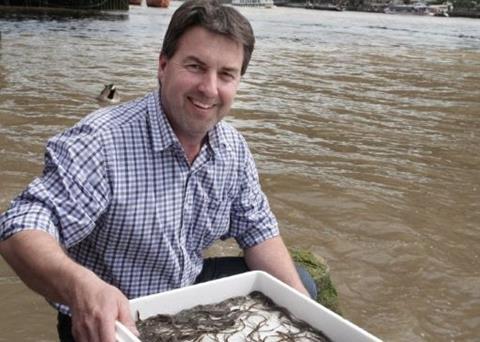
A number of projects have been established across northern Europe through the SES. One of the most noteworthy is on the UK’s River Severn – a historical centre for eel culture. It’s from here that a small number of hardworking fishermen are catching matchstick-sized glass eels to restock Europe’s wetlands, waterways and lakes.
The commercial season for glass eels starts in France in January or February and on the Severn in March/April, finishing in June or July. Severn fishermen will only go out catching with nets on the nights of the big Spring tides, equating to about six nights of fishing every two weeks, but on any one fishing night, an eel holding facility could take delivery of as much as 600kg of eels, for which the fishermen are paid around £200 (€242/$310) per kg.
At the facility, the fish are looked after in special cold, dark containment systems and then later despatched live in sealed polystyrene trays.
Education
One of the region’s leading commercial seafood businesses, the Severn & Wye Smokery, which supplies high-quality smoked fish (but not Severn eels) to chefs, has taken it upon itself as an SEG member to educate UK school children about eels. Last year it started a scheme of putting a glass eel tank in its local primary school as well as one at Billingsgate Fish Market in London.
The school children looked after and fed the eels twice a day for about 10 weeks. During this period they learnt about the important fishery that’s on their doorstep. They then released the fish in the lakes at Highnam Court, Gloucestershire, as a restocking exercise.
This project proved to be such a success that Severn & Wye will be rolling out 50 tanks to other schools across the country this year.
According to Richard Cook, MD Severn & Wye Smokery, the biggest problem is that approximately 98% of the glass eels that enter the Severn every year die in the river – their migratory pathways are blocked by concrete and steel so they can’t get out of the system. The good news is the UK Environment Agency, under the aforementioned EU recovery regulation, is now spending millions of pounds nationally unblocking these paths.
In the meantime, as a company, Severn & Wye doesn’t believe that any adult eels should be fished for in the river system, Mr Cook said. “We think this is depriving the wild stocks from being allowed to grow.”
Bad press
Dispelling the misinformation that has come from a proliferation of incorrect articles written about the demise of the eel will be an uphill struggle, but SEG members believe the eco-label could be just the shot in the arm the eel needs.
“We’re not conserving eel because it’s pretty to look at; we’re offering conservation because it’s an important source of food – not just for us but for other fish and wildlife. There’s no quick win but it wouldn’t be right to do nothing in the same way that shutting down the fishery wouldn’t be right,” said Mr Cook.
The next step is to get market/consumer recognition for the new eco-label and it’s widely believed the best way to achieve this is in restaurants, with the support of sustainability-savvy chefs.
“We want to engage more schools and more chefs in 2012,” confirmed Mr Cook. “The chefs can really drive this forward. At the moment they are understandably nervous because they have conservationists on their backs, but we hope the launch of the eco-label will be strong enough that conservationists feel easier about the fact that eel is going to be eaten.”
And how long before the European eel population fully recovers? It could take 15 years or it could take half a century, but for many involved with the SEG the most important thing is to take action and build towards a sustainable, commercial future.