




A new EPIRB has been launched by Norway’s Hansen Protection, which makes it easier to locate people in distress at sea.
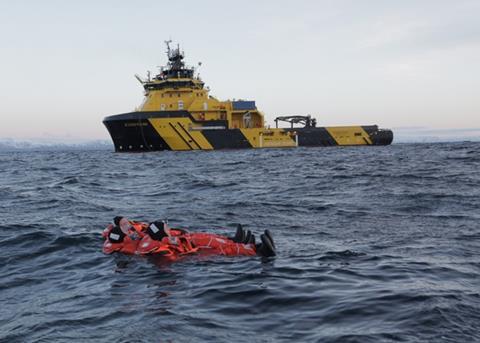
The company has developed the new emergency beacon that will initially be fitted into survival suits worn by workers on offshore oil installations. Over time, anyone who works in vulnerable conditions at sea, such as fishermen or people working on offshore wind turbines, can have the emergency locator fitted in their workwear.
“The new distress radio beacon takes cross-bearings from multiple systems. Several vessels can participate in search and rescue, and locating survivors becomes a lot more probable,” says Hansen Protection section leader Knut Asle.
“Previous tracking transmitters used by offshore oil workers have only transmitted signals on the 121.5 MHz (VHF) emergency wave band that only rescue helicopters and rescue boats could pick up. But now we have developed a radio beacon that combines signals on several different frequencies”, said Mr Asle.
In addition to sending signals over the emergency frequency, it also utilizes AIS, which is an anti-collision system for shipping. The beacon also uses the American GPS satnav system and its Russian equivalent, Glonass.
“It’s particularly important in the far north to use the Russian system. This satnav network is located further north and helps make locating a person in distress safer and more accurate”, said Mr Asle.