

Marine farming and artificial islands
Last January I went to a conference, which took place at the University of Haifa, Israel. It was dedicated to examining the option of artificial islands (‘artlands’) in an Israeli context.
If there is a country whose coast is most unfriendly to such an idea it is Israel. This is because the whole seaside of Israel and of the Gaza Strip, down all the way to the Egyptian Bardawil Lagoon and the Nile Delta continental shelf, is practically opened to the sea, and apart from the limited area between the Haifa Harbour and the Acre marina, is wanting of sheltered waters.
But, if there is a country that needs artlands to solve many of its problems, it is Israel. This is because its whole coastal area is one of the most densely populated in the world, because Israel, which population growth is one of the world’s highest, has no practical options to develop eastward, and because many current and future problems stemming from industrialisation and the resulting pollution could apparently be best handled on offshore artlands. In addition, artlands could be incorporated into expanding offshore oil and gas extracting systems and serve as extensions of air, ports and shipping terminals, as well as sport, recreation and entertainment, residential centres, and, in certain constellations, as infrastructure for power and desalinisation plants, and military and fish farming installations.
The various proposals brought up at the Haifa meeting also suggest coastal and offshore development, including or based on artlands, at the Gaza Strip (Palestine), which undoubtedly is in need of similar solutions and for similar reasons (see below).
Artlands
Artificial or man-made islands can be constructed in various ways. They can be based on existing islets and reefs, or on natural islets combined into a bigger island. They’ve been known from times immemorial, mainly as floating structures or built on stilts on lakes and other protected waters. In modern times, man-made islands have been created mainly by land reclamation. This is apart from land sections becoming islands incidental to flooding of valleys, etc.
Artlands may vary in size, from small islets reclaimed or constructed to support a building, a seaborne extraction facility, etc. to huge ones able to support entire communities, cities or airports.
Technically, the options for Israel’s coastal development are numerous. They may consist in reclaiming shallow inshore sections, as islands close to and parallel to beaches, or just as extensions of the existing coastline westwards, thus creating a new coastline – in inshore or offshore artlands, either filled solid top to bottom, supported by, for example, ‘spongy’ concrete construction that absorbs wave energy, or on stilts. Finally, come floating islands of various sizes, according to their purpose, which can be anchored offshore.
There are several options for connecting artlands to shore – where the distance is relatively short this can be achieved though bridges (also floating), by boats, ferries and helicopters.
Professor Michael Burt, a veteran coastal architect-planner is one of those who suggested considering a Palestinian option for artlands along the 45km long coast of Gaza, where the growing population of over 1.7 million is crowded on an area of 350km2. The target could be a marine coastal area of some 500km2 where artlands-based development could take place, and where, according to Professor Arieh Isar, Palestinians would engage in marine farming.
Perhaps, also Egypt could be thinking of constructing artlands. This is because of the rising sea level at the Nile Delta that is forcing some farmers off their lands and others to import sand in a desperate bid to turn back the tide. Also, climate change, if it continues at the present rate, may have a major impact on the Delta’s farming, tourism and human migration, aside from its ecological effects. Some experts predict that the continuation of such process and the resulting conditions could trigger food shortages that might turn millions of Egyptians into ‘climate refugees’.
Fishery
A relatively large artland may serve as a dedicated vertically integrated fishery center and a shelter for its fishermen and fish farmers. It may provide services for both fishing and cage farming, including residential facilities. It may also carry fish handling and storing facilities, as well as fish processing plants. Both industries should produce income that within a reasonably short period would recover the construction costs, apart from covering current maintenance expenses and fish production costs. Otherwise, an artland may be constructed with fish farming as its sole purpose.
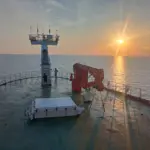
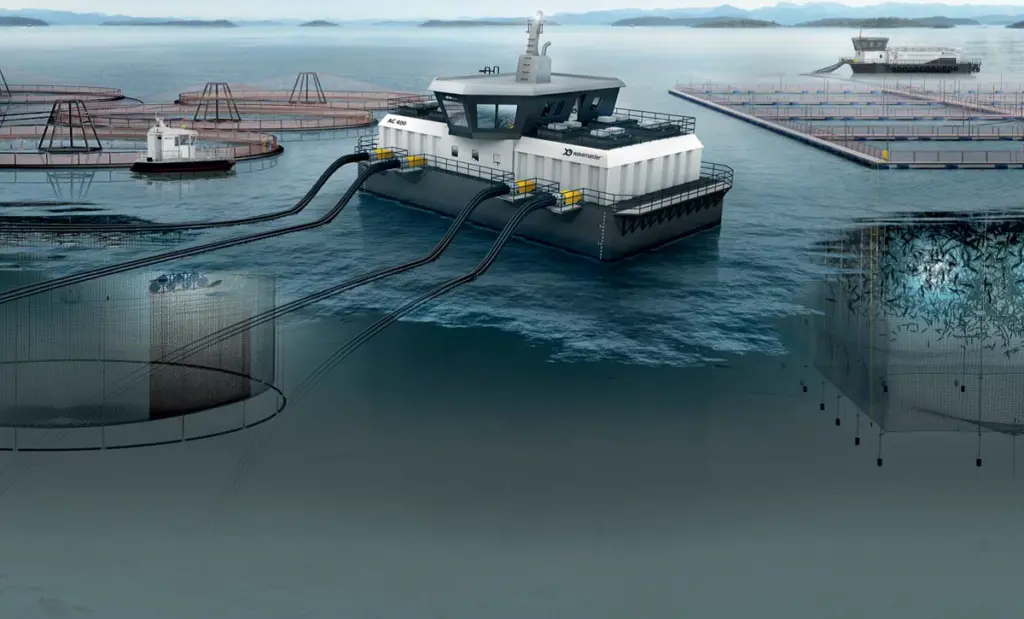
Another option is a special floating or stilted structure that can be considered a small artland with a mooring arrangement for service-vessels, with feeding and fish charging and discharging facilities. It would support an underneath and alongside set of fish cages, which is the most cost-effective way to grow fish in the open sea. Such marine farming systems can be based on modified ships, barges, or platforms, and would in many cases attract fish from vicinity serving as FAD (fish attracting device). Such FAD may sustain growth and development of various food organisms within the cages and in their vicinity, improving food supply to the fish inside the cages.
But fish cage farming systems can also be installed ‘piggy-back’ at any artland where it is technically feasible, whether alongside or underneath. Such additions could substantially increase the artlands’ economic feasibility. In some cases it may be more convenient and cost-effective to grow fish fry in separate installations, even land-based, and populate the seaborne cages when they reach the suitable size.
A whole marine farming system consisting of a centrally situated artland with all the relevant services, around which a chain of submersible fish cages is anchored was suggested by the AKVA Group. Here, the cages are freely ‘ventilated’ by sea currents in a way in which one cage is not too much exposed to the waste coming from the others.
So far, various artificial islands have been constructed or reclaimed, mainly in Japan, the Netherlands, and the Persian Gulf. It seems that for the Levant Basin it remains a far cry.