



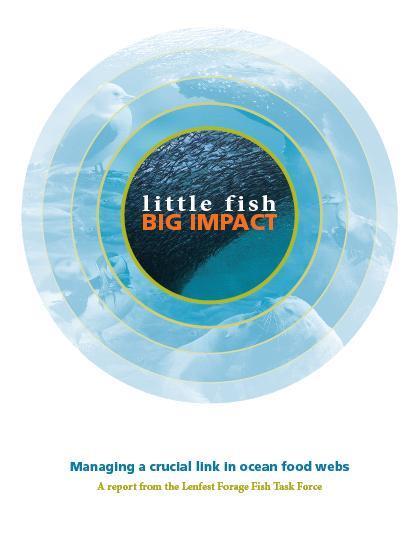
The recently published report by Lenfest Forage Fish Task Force (LFFTF), entitled Little Fish – Big Impact that glows in some media, calls for cutting the catch of forage fish by half.
The authors are 13 marine scientists sponsored and supported by the Lenfest Ocean Program of the Institute for Ocean Conservation Science at Stony Brook University, establishedwith a Pew Charitable Trusts grant, and supported by Pew and other organisations and donors.
LFFTF was lead byDr Ellen K Pikitch, herself a Pew Fellow (2000-2003) in marine science, administered by Christine Santora, previously a senior research associate with the Pew Institute for Ocean Science, and advised by Chris Mann, a senior officer with the Pew Environment Group and a former ocean and coastal policy director for the Pew Oceans Commission. Out of the 13 co-authors of the report, at least 11 have been in various ways in the past or the present associated with Pew, making LFFTF a very Pew-produced act (see my column Call of the Pew from November 2003).
The report is extremely well written and illustrated. It urges a "rethinking of the common belief that the populations of little fish can be maintained no matter how aggressively they are fished". The authors concluded that "forage fish are not only more vulnerable than previously thought, but also worth more in the water than in the net, because of the many species of larger fish, seabirds and marine mammals that depend on them". To bridge knowledge gaps, they urge erring on the side of forage fish so they can rebound quickly.
Computer models
LFFTF quantified the commodity and food values of forage fish for other commercial species, using 72 (!) Ecopath computer models of marine food webs, which, however, do not capture changes in ecosystem dynamics and fishing effort over space and time. To simulate the effects of various fishing strategies on forage fish and their predators, they used 10 (!) Ecopath-with-Ecosim models, including the newest version, EwE6, developed, how not, with support from the Lenfest Ocean Program and the Pew Charitable Trusts.
LFFTF concluded that with the conventional management by 87% of MSY (maximum sustainable yield) the probability of the stock collapse would be 42%, but with catch cut to 50% of MSY, it would be only 6%. Only 10% of forage fish, which represent 37% by weight of the world’s commercial catch, go for direct human consumption, others being processed into fishmeal and oil. LFFTF calculated the monetary value of the forage fish catch at about US$5bn, as against their value as food to its predators of about US$11bn.
All this was a desk-study based on data derived from stock assessments, ecological studies, biomass estimates, total mortality estimates, consumption estimates, diet compositions, and catches. Dr Pikitch et al, used plenty of estimates, speculations, approximations, and assumptions in their models. The resulting error range would be greater than the sum of errors of the input elements. The result cannot be very reliable, to say it delicately…
Models say different things to different people. For example, Professor Lennart Persson of the Ume University in Sweden, and his collaborators at the universities of Amsterdam and Tromsö showed that fishing prey would favour its predators, as dwindling populations of Baltic cod would be able to recover with fishing targeted at its prey. Using a mathematical model, they found that salmon trout in depleted lakes could be revived by culling its prey - char, as confirmed during a 26-year experiment in Lake Takvaln in Norway.
A dubious medicine
LFFTF admittedly drew much of its conclusions from speculations, assumptions, and estimated and approximate data. It also admits that forage fish abundance is highly variable, often unpredictable, particularly difficult to detect, doesn’t always recover readily from depletion, and concludes that conventional fisheries management is not conservative enough to protect forage fish populations from collapse, or to prevent impacts on other species. They suggested applying a precautionary approach in favour of fish, and what would "often be useful, and at times crucial ", management by seasonal and area closures.
Although the report contains some verbal remarks concerning the non-fishing dynamics’ influence on the booms-and-busts of forage fish populations, it failed to produce real data and correlations. For such, see for example, Klyashtorin, LB 2001, Climate Change And Long-Term Fluctuations Of Commercial Catches: The Possibility Of Forecasting; FAO Fisheries Technical Paper (410); Klyashtorin, LB and AA Lyubushin 2007, Cyclic Climate Changes and Fish Productivity.VNIRO Publ., Moscow; (see this column of August 2008), and Sharp, G D 2003, Future Climate Change And Regional Fisheries: A Collaborative Analysis, FAO Fisheries Technical Paper (452).
None of those are mentioned in the authors’ references.Neither is the word ‘pollution’,which is really a pity, because Atlantic and Pacific herring spawn inshore, often in polluted intertidal and tidal areas, river herrings and menhaden in and near estuaries affected by habitat loss or degradation and upstream and longshore pollution, Japanese sardine and sandeel in coastal waters, where population growth and related pollution/runoff, etc., have become major issues.
It’s hard to believe, therefore, that LFFTF’s, main conclusions are compatible with the dynamics of climatic influences on fish populations. Furthermore, in their economic analysis the authors didn’t include data for that part of preyed-upon fry and juveniles of large fish, because most Ecopath models don’t cover age structure.
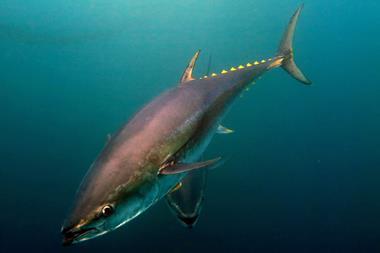
Another aspect: To gain 1kg in weight wild tuna or salmon must consume about 10kg of prey. Any swing of forage fish from industrial use to direct human consumption would give humanity at least 10 times the amount of protein than would those fish be left in the ocean. And how sure can we be how many of the forfeited forage fish are consumed by predators that reach markets and not by those uncaught in the sea?
The whole issue is far from being unequivocal. I’m afraid that the noise is bigger than the weight it carries...