

Lessons learned in the fight against EMS
The widespread shrimp disease continues to be a multi-billion dollar problem, but there is reason for rising optimism, writes Jason Holland.
Disease is widely regarded as the primary risk to aquaculture production growth as it undermines all other risks as well as market development and investment. Across the industry, shrimp farming has proved particularly susceptible to disease in recent times and the No.1 challenge currently impacting the sector is early mortality syndrome (EMS) – more technically known as acute hepatopancreatic necrosis syndrome (AHPNS) – which has devastated production sites across South East Asia and Central America.
The EMS/AHPNS pathogen was identified as a unique strain of the relatively common bacterium Vibrio parahaemolyticus in 2013 by a research team led by leading shrimp pathologist Donald Lightner, by which time it had already caused the shrimp industry losses exceeding $1 billion (€799.6 million).
EMS can bring high mortality, especially in the first 30-40 days after stocking ponds, by colonising the stomach of shrimp and producing a toxin that inflicts considerable damage to the hepatopancreas. The disease can be carried in broodstock and larvae as well as in live feeds. It can also be transmitted fecally/orally and by water.
It was first observed in China in 2009 and then on farms in Vietnam and Malaysia a year later, but didn’t grab any big headlines until the end of 2012 when it emerged in Thailand, the world’s leading shrimp producer and exporter. The following year, Thai shrimp production plummeted 50% to 270,000 tonnes and other major producing countries also fell foul.
As a result of tighter controls and other measures, Thailand’s shrimp industry is expected to produce 300,000 to 320,000 tonnes in 2014, rising to 400,000 tonnes in 2015 and 500,000 tonnes in 2016 if it continues to resolve its EMS issues. Before the outbreak, it was producing between 500,000 and 600,000 tonnes of shrimp per year, peaking with 610,000 tonnes in 2010.
Missed opportunity
The total global production of shrimp is expected to reach 3.5 million tonnes in 2014 but not reach the pre-EMS output level of 4 million tonnes until 2016.
At the recent Global Aquaculture Alliance (GAA) annual GOAL (Global Outlook on Aquaculture Leadership) conference in Ho Chi Minh City, Vietnam, where EMS was the hot topic, James Anderson, head of the World Bank’s global programme on fisheries and aquaculture, confirmed shrimp production from 2006 to 2012 increased at an average rate of 4.4% year-on-year. Then between 2012 and 2013 there was a 19% decline.
The projected growth rate for 2014, 2015 and 2016 is 7.9%, says Mr Anderson. Yet he further estimates that between 2013 and 2016, some 3 million tonnes of shrimp would have been lost to EMS, assuming the industry maintained a 4% growth rate.
“This disease is a multi-billion dollar problem, particularly when you look at where we are and where we could have been,” he says.
Nevertheless, production increases are expected in all countries in the Asia region by 2016, says Mr Anderson, adding that in Latin America, Ecuador has taken advantage of the situation in Asia and Mexico and its production in 2016 is expected to be 28% higher than in 2013.
A turning tide
Because EMS is a very complicated disease, GAA recently conducted an online survey of shrimp farmers to establish a clear picture of the broader challenge. The idea is that once the trends are understood, GAA will go back and conduct in depth, on the ground facility audits, George Chamberlain, president of GAA, told the GOAL conference.
“The good news is the tide is turning. There are a number of bits of information that are all coming together and helping producers return to production following EMS,” he says.
Preliminary survey data suggests the best way to address EMS is through an integrated set of solutions that span the entire production chain, incorporating such things as better diagnostics to reveal more about where the disease is and how it is moving, as well as genetic advances to improve EMS resistance.
With regards to the latter, a subset of farmers in Mexico reported significantly better results from a different genetic line of shrimp that they are using, reveals Mr Chamberlain. “This could have dramatic implications for the whole shrimp farming business. The next step is to go back to Mexico and verify this trend.”
One of the key pieces of information to come from the survey at the hatchery level is that the live polychaete worms widely used to induce reproduction in shrimp are often heavily infected, having been sent from disease affected areas.
“That could be one of the main smoking guns for how this disease has been transmitted.”
At the farm level, many different factors are helping the cause, including stocking larger post-larvae animals, using groundwater where available and managing algae blooms. In addition, a number of feed additives have been shown to support against EMS, he says.
“What we need to do now is put it all together; there isn’t a single silver bullet for the process.”
A glimpse into the future
The battle against EMS is shifting from guessing what to do to implementing what works, says Mr Chamberlain. However, he warns that new shrimp diseases continue to emerge. In particular, a Microsporidean parasite that causes slow growth and, like EMS, affects the hepatopancreas is causing problems in China, Vietnam and Thailand. Chinese production was also recently hit by the Covert Nodavirus.
“The journey of trying to overcome shrimp diseases will never really end. But with each step we are developing better controls, improving our resistance to disease and reducing the risk.”
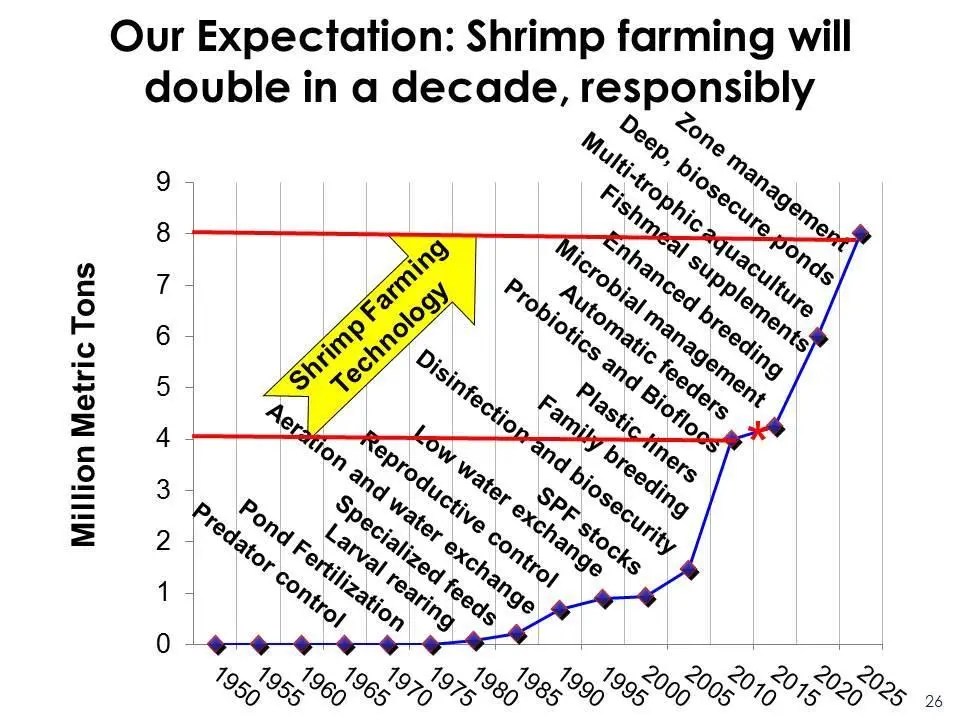
GAA says the next effective step is zone management, which will have many advantages, including the ability to control proximity among farms. Therefore it has established a Zone Management Technical Committee to initiate the process of drafting Best Aquaculture Practices (BAP) certification standards for zone management, with a view to it becoming a fifth BAP star, joining Processor, Farm, Hatchery and Feed Mill.
With zone management, more sophisticated breeding programmes and a more responsible way of working, GAA believes shrimp aquaculture could go on to reach 8 million tonnes per year by 2020, effectively doubling the global output in a decade, says Mr Chamberlain.