



Since the RAC’s seminar in Edinburgh on cod recovery, World Fishing has received important information from scientists in Norway.
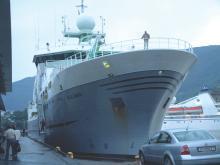
One such scientist was honest (and scientific) enough to tell a public debate at Nor-Fishing in 2004 that stock data they produced could often be out by 50 per cent, plus or minus. The Marine Research Institute now tells WF the high-profile silence which has been a key element in another data capture issue has been exposed by the humble herring. Yes, the herring has blown a hole in the side of what we all reported was probably the most silent ship in the world, the “G.O. Sars” research vessel which was built for stealth. The good thing is that other scientists can learn from Norwegian honesty.
IMR says the International Council for the Exploration of the Sea (ICES), has recommended fisheries research institutions worldwide invest in new, ‘silent’ research vessels. The idea is silence means you get so close to the fish that they are in a sample trawl before they know it. This was to avoid, IMR says, “biasing results from stock abundance surveys. However, comparative studies carried out by IMR show that the silent vessel “G.O. Sars” initiates stronger and more prolonged avoidance reactions in herring than a standard vessel”.
Thank you IMR for honesty, once again, about mistakes – and silence, the latter literally costs millions for the vessels as well as decisions on possibly bad data. The new Secretary General of ICES, Dr Gerd Hubold told Edinburgh that one of the difficulties ICES faces on data is that essentially ICES collates, not creates, the data sent in by scientists from each country, so data quality is not really in ICES’ hands.
This swings us round beautifully to Icelandic fisheries’ consultant Jón Kristjiánsson who has a reputation for thinking outside the box both scientific and bureaucrat. He was both the former and the latter, before setting up his own intellectual island and he has had to tie himself on more winter trawler decks than he can remember.
He explains about one massively expensive bottom survey of fish by scientists “It was so expensive they were unable to [accept it was a] failure and stop it. They involved the fishermen in the process so they [would also be] guilty with the wrong advice: ‘let them [the fishermen] think they have something to say’...But they never listen to them and all the evidence they get from fishermen they use against them, always,” he told WF.
One of the most experienced of the Scottish fishermen, with a catch record others drool over, but whose name we won’t mention as he is also a very modest fellow, told WF “You can hear too much science. [Yet] there is very little classification coming from them, very little about how to progress. Basically it is a mess. Any scientific body to come up with a statement like these would be laughed out of court.
“Basically the Commission has been taking the scientists’ view on bad science. There are only two sets of people who can solve it. The fishermen and the policing agencies”, he said.
“From an industry point of view, with the Commission, every year there is a buzzword, and this year it has been discards.
“Now, there have been discards for the last hundreds of years. Discards should have been solved 20 years ago.” He said the Commission should follow the Norwegian model. “If the Norwegian fishery comes on board and we have 15 per cent of haddock under size, we are told to move on. If they see we have been towing back and forth, up and down, they will come on board and it is straight into Norway and we are fined. The European fisheries could learn a lot from the Norwegian fisheries. But the problem they have is that policing the way the Norwegians do it is too expensive. That is the problem. That is the bottom line. I have been a skipper for 10 years and I have been boarded by a British boat once in my life. I mostly fish the Norwegian sector and it is very seldom we go three weeks without a Norwegian inspector on board.” Nor are they like policemen coming on board. “They have a mentality [like] the fishermen. They are switched on [but] They can suss out [if you are up to no good].
‘“We are banning discards’ – it looks good – big headlines. But this was just the Commission finding an easy way, so that in the month of October [when] the whiting quota is finished, what they do is shut down the whole fishery.
“I think they have to take a page out of the Faroese [book]. The Faroese police use a quota system, days at sea, and the boats go out and catch the fish and whatever they catch they land. So there are no discards. Everything is landed. The following year, if the stocks are down then they reduce the days. There’s no fish being discarded. Everybody says ‘that’s it’. The EU has got so big and made itself so complicated they have made it impossible.”
He agrees that along with landing everything there should be more promotion of seasonal fishing. “The problem with that is the supermarkets want a certain kind of fish all year round.” He says it should not be too difficult to change that and promote seasonal catches. “January, February and March are the most important time for cod when they congregate in big hauls. The prices are poor, we are having to quota catch it, so you can’t fish it. There is plenty of haddock and whiting in this area – so why not just shut those areas off” [and promote haddock]. “Haddock prices have increased 50 per cent in the last two years without promotion! That’s the kind of thing for the supermarkets to do. A fisherman [on his own] like me cannot solve a problem like that – it is too big.” But he believes that fishermen and their organisations could bring it about.
These views only confirm what the Royal Society group on fishing said a few years back in WF. It published a report which said that often the information which scientists were handing (under time pressure) to ministers was often only guesstimates with no real basis. It made a blistering attack on the fishing ministers for taking decisions on such a basis. This of course destroys the credibility of scientist’s own science.