


Both, the monster created by Shelley''s fictional Frankenstein character and the legendary Golem of Prague created by Rabbi Maharal, were made of dead material and put to life by magic.
In genetic modification of live organisms neither dead matter nor magic are employed, hence, calling the much disputed genetically engineered salmon (GE-salmon) frankenfish or franken-salmon is a bit far-fetched.
Growth hormone genes
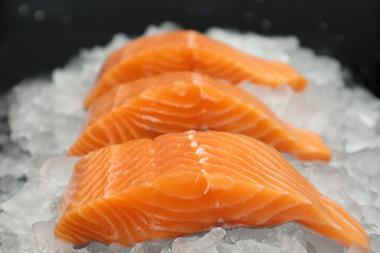
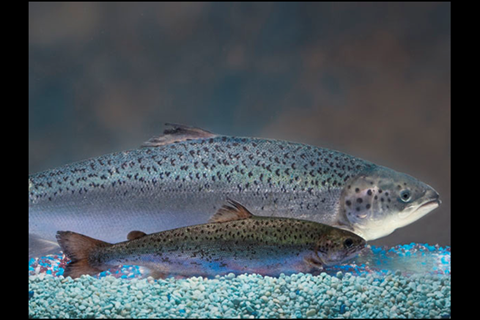
It all started in the 1980’s, when Garth Fletcher, Choy Hew, and Peter Davies of Memorial University in Newfoundland and Queen’s University in Kingston, tried unsuccessfully to improve survival rate of Atlantic salmon in ice cold water by injecting it with genes of other species. What, however, succeeded was to produce in 1990 a fast growing salmon by injecting growth hormone genes from Chinook salmon and a genetic on-switch from ocean pout that causes continuous creation of the growth hormone. It takes the GE-salmon approximately 10% less feed and only 16 months to grow to the same size and weight, which normal salmon needs three years to reach, and the resulting fish are sterile.
To exploit their innovation, they had become partners with A/F Protein in a new company called AquaBounty Technologies with a research facility on Prince Edward Island, Canada, where GE-salmon is bred and grown, employing the technology developed at Memorial University in Newfoundland. They are planning to raise the GE-Atlantic salmon inland and process and ship it as table-ready fish to the US. In any case, the opinion is that it tastes as any high-quality Atlantic salmon.
In September, 2010, the U.S. Food and Drugs Administration (FDA) declared that GE salmon is as safe for the environment and human consumption as other Atlantic salmon, and that it's "extremely unlikely that this salmon would ever be able to survive and migrate to the Pacific Ocean" - a preliminary analysis still to be formally approved. This makes the GE-salmon the first genetically engineered food animal to be approved for human consumption.
But, obtaining official approval is not going to be easy in view of the fact that last February US Congressman Don Young (R) from Alaska and a bi-partisan group of 30 others moved with a law proposal aimed at prevention of the sale of genetically engineered salmon in the US. The House motion follows a Senate bill introduced at the end of January.
Misgivings
The intention of allowing the marketing of GE-salmon to American consumers was met with quite a lot of scepticism and criticism. One question raised was whether or not it is safe to eat genetically modified fish. Another was how important it really is?
Genetically modified organisms (GMOs) have long been a controversial issue in agriculture. However, the global debate about their possible risks to human and environmental health, in part inspired by moral values, sometimes rather sanctimoniously, has continued at such a scale that the FAO expressed some doubts as to the GMO's contribution to meeting the increasing demand for fish in the short-term.
One allegation of the opponents to GM products is that the processes involved have been patented and thus become exclusive "property" of the agribusiness and corporate interests, which makes them expensive to the final producers. In the GE-salmon case, some of them worry that AquaBounty will become its sole producer. Another bone of contention originates from the economics of wild salmon fisheries; FDA is criticised for not studying the economic impacts of allowing marketing of GE-salmon on the US. and Canada's NW Coast wild salmon fisheries.
Some people in the USA are raising the question of labelling. Legislators have introduced bills requiring obligatory labelling of GE fish and their products so that consumers know what they’re buying. In Canada, the Dept. of Fish and Oceans (DFO) voiced its qualification of the need of risk assessment that will focus on potential effects in Canada, and on the potential risk to Canadian wild fish stocks. Consequently, AquaBounty must undergo a separate regulatory approval process in Canada. DFO requested also that containment and limitations to which companies in other countries will have to comply be clearly outlined.
While the above qualifications carry rational argumentation, the loudest salvos aimed at FDA's study seem to be coming from a mixed crowd of anti-GMO activists, some with religious motives, and super-environmentalist NGOs and their lobbyists and advocates, including a group of House members and senators who seem to just hate the very idea of "interfering with creation". Their arguments are based on worries, superstitions, and speculations as to what may happen – and the list is long. The problem is that they're not offering any evidence supporting their allegations. Nevertheless, AquaBounty insists that the technology is safe. "We believe the economic and environmental benefits of our salmon will very effectively help to meet the demand for food from the growing world population," said Ronald Stotish, president and CEO of the company. "The US market alone is massive, with the country importing as much as 300,000t of salmon per year".
It is hard to dispute either the ideological resistance or that of "precautionary approach" advocates, which are not based on actual findings, for one cannot dispute beliefs. On the other hand, the opposition from the side of the world's salmon fishing industry is fully justifiable. The wild fishery suffers from ups-and-downs, is quarrelling with floating salmon farms that often affect immediate habitat and also broadcast sea lice, and can really do without additional competition on the part of super-salmons. But, is it trying to prevent or hamper the marketing of the GE-salmon the right US strategy? If not the North American wouldn't those be Chinese and other Far Eastern GE-salmon producers, who'd raise and, sooner or later, supply the super-salmon to American consumers?