




Geneglace explains why quality of product is becoming more important - Due to the variation of farmed shrimp volume, market price for shrimp have become very volatile in the past few years. So much that shrimp production has become a high risk activity with prospects for both fast earnings and losses from year to year.
To be successful, shrimp producers are left with no other alternative than closely mastering the quality of their fragile seafood. Among the various criteria, freshness is ranked by Japanese importers* as the most important quality factor... even before appearance, taste or size.
Freshness with flake ice
Keeping shrimp in ice allows for consistent quality. Since the melting temperature of ice is zero degrees Celsius, irrespective of ambient conditions, shrimp remain near this ideal temperature as long as there is plenty of ice to cover them. Ice enhances the market appeal of shrimp, brings safety, sanitation and a longer shelf life.
Among the various kinds of ice, flake ice is especially suited and has become a standard for shrimp applications.
The cooling power of this sub-cooled ice is excellent because it is a dry ice. One kilo of flake ice absorbs 83 kilo calories from the shrimp in the melting process, thus cooling them fast and preventing from product de-hydration.
The Venezuelan experience
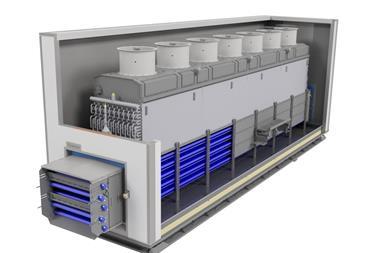
Ice production facilities are a must in modern shrimp farming business. Ice plant recently installed in several Venezuelan farms have proven their effectiveness. In the Maracaibo region, on the west side of the country, the industrial refrigeration company INPROINCA installed a number of large Geneglace flake ice machines, producing 30 or 45 tons/24 hours each. In such a warm climate, the large production capacities are dictated by the need to use two kilos of ice for each kilo of marketed shrimp.
The cooling method
Just after harvest, the shrimps are dropped into insulated bins with iced water. The mix includes 500 kg of shrimps, with 300 kg of ice and 200 litres of water.
The freeze shock method - which is also commonly used for fish - kills the shrimps while quickly dropping the core temperature below +4°C.
The full bins are brought back ashore to the processing factories, which often are several hours away from the production areas.
From arrival to the factory and throughout the processing phase (head cutting, sorting, peeling...), the shrimps must remain in ice. Venezuelan shrimp processors are well aware of this critical point. Some argue that a shrimp looses weight as it warms up.
The loss being as much as 1 % per marginal degree above +5°C, keeping shrimp in ice can induce substantial savings.
On the way to rationalization
For many years, shrimp processors bought ice blocks which were crushed upon request.
Due to the reduced cooling power of block ice, the total quantity required was threefold (3kg of ice per kg of shrimp).
The cooling capacity of flake ice being higher, the ice consumption can be reduced. Hence the use of flake ice allows for a more favourable ratio while improving the quality of the product which is more quickly cooled.
*According to a survey performed in 2000 by Dr Yoshihito Itoh among Japanese shrimp importers.