


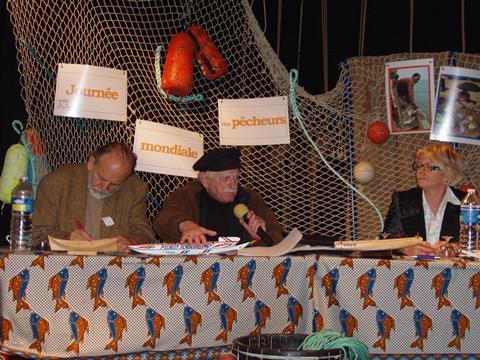
The headquarters of P&D, which also include a fisheries documentation centre, is situated in Lorient in Brittany, France. Lorient is the second largest fishing port in France handling annually (2008) over 22,000mt of catch and Brittany supplies 40% of the French-caught marine fish.
World Fisheries day is celebrated every year on 21 November throughout the world by fisherfolk communities through rallies, workshops, public meetings, cultural programs, dramas, exhibitions, music shows, and demonstrations to highlight the importance of maintaining the world’s fisheries, fishing people and their communities. The Lorient workshop was an opportunity to reflect on the economic, social and cultural importance of fishing in France and to discuss the current management of its fisheries.
P&D is a nationwide organisation with two main aims: supporting fishermen and their communities in France and extending development assistance in African countries. The latter is similar to that of the International Collective in Support of Fishworkers (ICSF) of which Alain Le Sann, the Secretary of P&D, is a member.
The 2009 World Fisheries Day Workshop was held in Lorient with the rather turbulent times for the EU’s CFP in the background. Locally, there was uneasiness on the part of the fishing industry and, in particular, the smaller-scale sectors about the fisheries management methods and future of the CFP. The recent admission by the EU Green Paper of the need for the CFP overhaul, the often fierce criticism of the prevailing management system coming from different parts of the EU, and the Fisheries Commissioner Joe Borg frustration with the quota system and his proposal to replace it by input controls, such as the days-at-sea (DAS) allocation practiced in the Faroes, all added to the turmoil.
Daniele Le Sauce, P&D President, opened the workshop, which began with a presentation by Menakhem Ben-Yami about the inadequacies of the science used for fisheries management, and proposed that instead of wrangling over TACs and quotas, fishermen should have the underlying science reviewed and verified by scientists independent of the management and official-science system. This presentation was followed by a question-and-answer session. Next, Alain Le Sann (the workshop’s main organiser) led a panel under the heading “Fishermen are Experts too”.
Xoan Lopez, Secretary of Federacion Des Confradias de Galice (Spain), discussed the present status of the community management (Confradias) and the problems they encounter within the CFP. One problem is how to define what an artisanal fishery is. Since such definition would influence the future CFP and the consequent allocation of funds - it may be different from region to region. Elisabeth Tempier of the Mediterranean Branch of the P&D spoke on the historical role of the Prud’homies, a French Mediterranean artisanal fishermen’s local management institution, now over 200 years old, which has survived several external upheavals and is still well functioning.
One may say that both presentations added justification to Professor Elinor Ostrom’s 2009 Nobel Price in economics, who showed that many inshore fisheries have been handled very well by local communities that often can do better than state or privatised systems.
Bastien Malgrange reported on the D&P project to survey and to propagate among the fishing communities in Brittany the various local initiatives. These included: tagging of female lobsters; cooperation with farmers; reintroduction of sails to save energy; encouraging the process of line fishing as a replacement to trawling in territorial waters; direct marketing of catches; labelling of fish caught with hook-and-line; and self-management and policing of scallop fishery. All 4,000 fishing licenses in Brittany are managed by fishermen committees and their money is used to finance management costs and various initiatives. One such initiative was designing a net that releases nephrops (langoustine) juveniles in the Bay of Biscay, which earned them an international prize from the Food Alliance NGO.
Those who also participated included O. Le Nezet, President of Lorient Fisheries Committee, Secretary of Guilvinec Fisheries Committee, R-P. Chever, and EU PM and vice-commissioner of its fisheries commission, A. Cadec.
A. LeBerre, President of the Brittany’s Regional Fisheries Committee doesn’t agree that CFP is a total failure. He thinks that the historic rights of the fishermen of Brittany are preserved, but that the Green Paper lacks social perspective. While, according to the EU’s constitution the social status across Europe should be striving towards the high level, in the fisheries the opposite happens. F. Tretter of IFREMER, although he generally agreed with the criticism of the EU fisheries management and the underlying science, said that change was now occurring in the indicated direction.
Katia Frangoudes brought up the question of women working both in harvesting and as fishermen’s wives. In spite of increasing visibility, however, there’s still an inherent resistance to give way to women’s integration, especially in the decision-making process.
The gist of Menakhem Ben-Yami’s second presentation was that almost every fishery needs separately tailored management based on the life histories of the species interacting in the area and that single-species management in a multi-species is often counter-productive. The workshop terminated with a panel with elected local authorities and representatives of fishermen organisations.