


I started my marine career as a wireless operator. An upcoming ‘sparker’, as we were fondly called by other seamen, one of the first subjects they taught me at maritime school was how to react to safety problems and, in particular, when yours or other ship was in distress.
Obviously, it was the sparker's task to radio for help, which in those times consisted of Morse-code message starting with SOS (in Morse: …---…). Asked by our instructor, a blunt WW2 British Navy veteran, what does SOS mean, remembering some of the sea-lore books I read, I answered: “Save our souls.” “F**k your souls”, said the guy, “it's save our ship!”
This was over 60 years ago, nevertheless when I looked up SOS in Wikipedia I found the following: “In popular usage, SOS became associated with such phrases as ‘save our ship’,and‘send out succour’.Well, nowadays, the Morse-run radiotelegraphy belongs to history if not archeology, and instead, the expression “Mayday”repeated thrice is the international distress signal. According to the Wikipedia: ‘A Mayday call is roughly equivalent of a Morse code SOS. When they receive a mayday call the coast guard may launch lifeboats and helicopters to assist the ship that is in trouble. Other ships that are nearby may divert course to assist the vessel broadcasting the mayday".
In the old times the unwritten rule among seafarers used to be that you don't desert a vessel in distress. First, you do your best to save it and if you do you can claim a reward, with the boat itself serving as collateral.
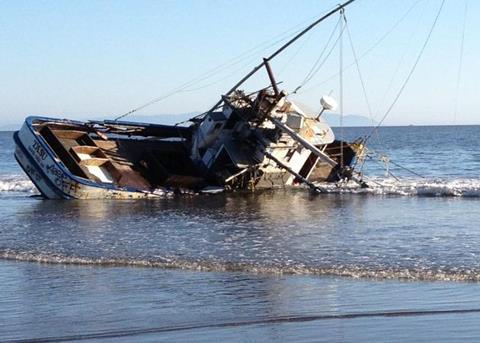
It appears that nowadays this rule is not always and not everywhere followed. At least it was not followed when on 13 October 2011, an old 48-foot classic West American wooden troller, the F/V Tasu, was grounded at high tide on the sandy beach at Bolinas (north of San Francisco, California). While she was still partly floating undamaged on a slack tide, the skipper-owner called the Coast Guard to give her a tow off the beach before the tide went out and Tasu would lay over, possibly cracking her keel.
Well, whoever took the call at the San Francisco Coast Guard station asked whether the crew was OK, and when the skipper truthfully answered that positively, he was told to contact a private company, for it was the U.S. Coast Guard policy not to lend assistance in such cases. This, in spite that the Coast Guard, with divers and equipment, was less than 45 minutes away, and if the Tasu was not removed soon and the tide went out, the vessel could be heavily or even irreversibly damaged, with her fuel and oil leaking into the nearby National Marine Sanctuary.
The skipper called the private salvage company recommended by the Coast Guard. They asked for and he gave them his credit card number, but after a while they informed him that his credit was insufficient to cover their costs. As time was running out, other fishermen radioed that they'd help with the salvage costs, but still the company refused to come. While fishing boats in the area were willing to try to tow the Tasu from the beach, they had no means to run a line to the stranded Tasu, such as should have been available at the nearby S.F. Coast Guard station.
Battered
Well, some Coast Guard and also California Fish & Game staff did arrive, but by land, and only to make sure that fuel and oil were pumped off to avoid a spill in the adjacent sanctuary. They had no capacity or authority to avoid the loss of a $100,000 fishing boat and a fisherman and his family’s livelihood. Time passing, the tide went out and the boat remained grounded only to be battered by surf and tides.According to local press reports, Tasu was not insured.
Californian press also wrote that the Tasu tragedy left a wake of bad feeling among the local population and other fishermen. Especially that all of this could have been avoided, if both the S.F. Coast Guard commanding staff and the salvage businessmen had followed the old SOS ‘save our ship’ maritime rule. Then the Tasu would have been refloated and a fisherman’s livelihood sustained.
On the top of his misfortune with Tasu's grounding, her skipper had to hire a company to remove the fuel from the boat, to prevent an environmental hazard and then to have the wreckage removed, and bear considerable costs.
Additional irony of this tragedy is that the ‘Vessel Assist’ salvage firm's parent company is the Boat Owners Association of the United States (based in Virginia). Well, they said that they're going to investigate…
Maybe the fisherman should've exaggerated his situation and told the Coast Guard that he was in danger, too. Or maybe, the people who are paid to help mariners in trouble should have shown little flexibility with their rules and made some effort to save the boat?