





Digital Deep Sea launches new AIS aids
Digital Deep Sea has introduced a new range of AIS aids to navigation (AtoNs) called DigAtoN.
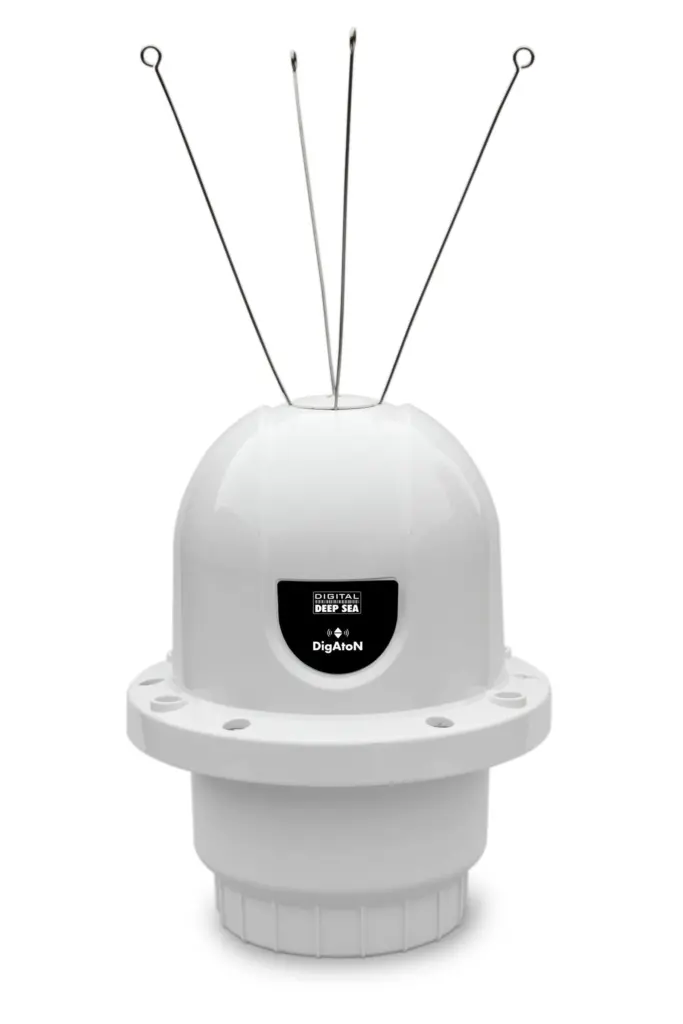
These are devices designed to fit to marine structures, lighthouses, wind turbines, hazards or buoys and can transmit AIS location and identification signals to nearby AIS equipped vessels and shore stations. They can then positively identify the position of these marks on a plotter or ECDIS, and can read data (such as weather and hydrological instruments) collected by the AtoN.
DigAtoNs can also be configured to represent a virtual or synthetic point if mounted remotely from a physical location, allowing a single AtoN to produce up to five ‘virtual’ marks.
The DigAtoN is available as a Class 1 device (transmit only) or a Class 3 device (transmit and receive). Class 1 devices require a local AIS base station to be operating in the same area as the AtoN whereas Class 3 devices can internally allocate slots for transmission allowing them to be placed anywhere. Class 3 devices can also be configured and queried remotely and wirelessly ‘chained’ together for extended range configuration.
DigAtoN products are also available with an additional sensor interface installed to allow extended monitoring and digital switching capability including analogue and digital sensing plus relay switched outputs.
S1000 AIS Smart SART
Digital Deep Sea has also launched the new S1000 AIS Smart SART.
A SART (search and rescue transponder) is a mandatory fit for life saving apparatus on all vessels over 300GRT. Traditional technology used a radar type device, but new legislation now allows an AIS SART to be used with associated performance and cost benefits. AIS SARTs positively identify the casualty and give a regular position update which can be graphically displayed on a Class A display, ECDIS or plotter.
The S1000 is a fully IMO compliant and approved AIS SART (Wheel Marked) which once activated, will display a target on any Class A or B transponder system or on an AIS receiver. SART alarms like Digital Yacht’s AIS Lifeguard are also activated by the signal from these devices. The S1000 utilises specialist VHF antenna technology to offer exceptional range (typically up to 10NM) and has a battery life of 96 hours under operation. It comes with a storage bag and bracket mount and has a 1m telescopic pole integrated so it can be used in a life-raft.
The integrated 50 channel GPS offers a very fast time to first fix (typically under 40 seconds) and thereafter position information is transmitted eight times per minute. The SART shows as a specific SART target on any AIS system and a safety message (SART ACTIVE) is sent every four minutes.
Related Articles
 FISHING TECHNOLOGY
 FISHING TECHNOLOGY
 COMMENT