



Climate, pollution and overfishing
It seems that at least every five years I have to return to the dispute of overfishing versus other factors responsible for depleted fish populations. I wrote about it on this page in 2002, 2007 and 2012. Now, with a feeling of déjà vu, Im back at it.
The trigger was a letter sent to me by a friend, in which a British fishing skipper was complaining of the lack of judgment with which the general press distributed misinformation “by conservationists who are self proclaimed ‘experts’…very good at manipulating the media who love them, and publish every dubious, or in some cases, completely false, stories given to the press”.
The skipper continues, “There has always been a strong argument that vagaries of tide, wind, and frequent weather changes make stocks of fish virtually impossible to predict. Famine and feast have co-existed around the coastal fisheries of our islands since forever, often without any logical explanation. Put a ban, or huge restriction, on certain species and they will appear everywhere, and then they will have to be discarded!”
In Israel
Recently, fishermen here came with a similar complaint, due to a press-wide campaign in which a local ‘nature protecting’ society – under the pretext of concern about the marine ecosystem – is attacking commercial fishermen. The society is blaming them for overfishing, while ignoring well-proven ecological villains – the sewage and seepage that are flowing into the Eastern Mediterranean from municipal, agricultural, and industrial sources (some treated and some untreated), as the sewage from the Gaza Strip, as well as pollution from shipping.
Our coastal waters are additionally affected by five sea-water desalinisation plants, which immediate saline surroundings remind that of the Dead Sea, where life is hardly possible. More damage to our coastal ecosystem is due to oil and gas explorations, their drilling and associated occasional faults, and laying underwater cables and oil and gas carrier pipes. Breakwaters, marinas and other beach constructions critically modify the character of the overcrowded coastal strip, where many commercial fish spawn and grow. On the top of all this, major changes take place in the catch composition of the Near-East commercial fisheries, due to Red Sea fish invasion.
News from science
It is strongly suspected in the USA and some other countries that such well-financed ‘green’ anti-fishing campaigns are in fact designed to distract the public attention from the ‘contribution’ of the petro-chemical and other polluting industries to the marine and fisheries ecosystems.
I hope that one day the official management will gradually swallow its pride and recognise that persecuting and harassing only the small and medium-scale commercial fishermen for the depletion of fish stocks and for hurting the whole ecosystem doesn’t hold water – all the more that in recent years more and more independent and governments’ own scientists, and even judiciary have recognised the undisputable.
According to a report published in the ICES Journal of Marine Science, a combination of fishing and climate change caused four fish stocks (black sea bass, scup, summer flounder and southern winter flounder) in Northeast US waters to shift significantly poleward. Increasing ocean temperatures and climate change are forcing fish to leave their habitats for a more favourable area, or to attempt to survive under less than favourable conditions. The recent northward shift of the summer flounder stock was linked to an increase in the number of larger, older fish, formerly creamed-off the population by selective fishing gear. The study is telling workers developing management modules and rules to consider multiple factors specific to individual species; otherwise they can cause a mismatch between the distribution of fish and the catch allocations for different regions and species.
It seems that the NMFS (US National Marine Fisheries Service) also recognised the impact on marine life of the maritime industry, pollution, coastal development, and catastrophic events in its 2013 report, but this has still to be applied throughout its management system.
Pollution
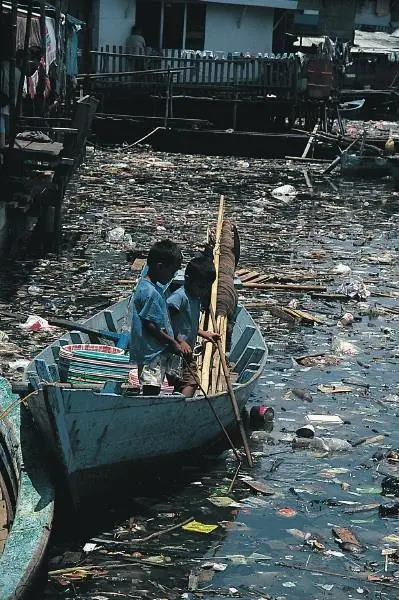
Marine pollution is the result of industrial and agricultural run-off, and municipal sewage, and may contain radioactive waste. It flows into the sea from land sources, mainly by gravity, carried by wind, or physically delivered and disposed of by people. Excessive inputs of nutrients enriches estuarine and sea waters. Resulting algal blooms may become anoxic and cause massive fish mortalities, while carrying toxic chemicals such as pesticides and toxic metals accumulating in micro- and macroplankton. Those arrive through bio-accumulation into the organs of edible, commercial species – they find their way into cattle, poultry and people’s diet, while causing harm along the whole food web. Dredging contributes millions of tonnes, making about 80% of all waste dumped into the ocean. About 10% of all dredged material is polluted with heavy carcinogenic metals such as cadmium, mercury, and chromium, and with nutrients and pesticides.
Recently, in Africa, Royal Dutch Shell has agreed to pay $84 million to residents in the Niger Delta whose communities had been devastated by the two massive oil spills in 2008 and 2009 that affected thousands of hectares of mangroves in south Nigeria. While justice was done, it took Shell six years to recognise the true extent of the damage these spills caused to the environment and to people’s livelihoods.
Science has got still a long way to go to establish the various effects of pollution and climatic trends and events on fish populations, as compared with the impact of fishing in the ever-changing, dynamic ecosystem. But fishermen are sick of being blamed for the depletion of stocks when managers close their eyes to all other factors. Wouldn’t you?