




Earlier this year, the Institution of Mechanical Engineers reported that of the four billion tonnes of food produced annually, between 30% and 50% is wasted. Andrew Martin looks at one of the ways in which more fish and shellfish could be utilised.
According to FAO, 40-50 million tonnes, or about one third, of the 150-160 million tonnes of fish and shellfish harvested annually are lost to human consumption.
In under developed countries wastage is usually caused by poor handling, including transport and storage infrastructure. Processing methods are also often inadequate. A consultant working in Africa says: “Fish is put out to dry in the sun where it is contaminated by rats and birds.”
In some countries, including those that are more developed, there is still no attempt to make products from the trimmings etc from processing. One tilapia operation in Asia failed financially because this material was not utilised. Says a former director: “We have got to use everything in fisheries.”
Equipment to utilise what was once considered processing waste is readily available. Baader, one of the world’s leading manufacturers of fish processing machinery, introduced its first bone separating machine more than 40 years ago. The Baader 694 extracted the flesh from trimmings and small whole fish that otherwise would have been used for reduction to fishmeal, or even completely discarded. It could also be used for shrimp, crabs and mussels.
“The extracted flesh (mince) was used to make fish fingers, fish burgers, fishcakes, even fish sausages”, says a company spokesman.
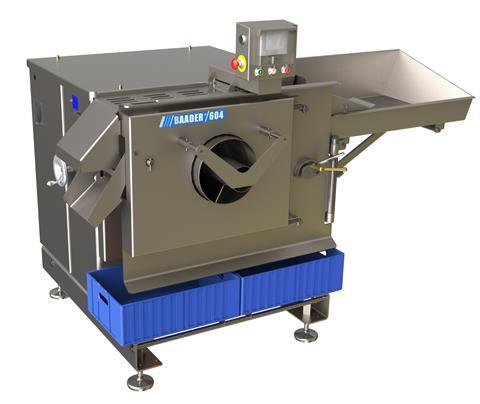
There are now five machines in the range, beginning with the Baader 600, the smallest, followed by the Baader 601, Baader 604, Baader 605 and Baader 607 which has the biggest capacity.
“The principle is the same in each machine,” Regina Dedow, marketing manager, says. “The main difference is the capacity and the big machines, of course, have more options, for example automatic feeding, hopper feeder, dry running sensors, touch panel etc.
“A squeezing belt feeds the product to a perforated drum and presses the soft components through the holes of the drum. The solid components, such as bone, remain outside the drum. The ratio between yield and quality can be influenced by adjusting the pressure roller. The throughput very much depends on the input product, for example H&G fish produce a much better yield than when frames are used.”
The Baader 604, designed for medium sized companies, is the latest addition to the range. Introduced last year, it has already been sold to fish processors in France, where it is being used on board a fishing vessel, and the USA. The machine is operated by one person and has a throughput ranging from 350kg to more than 4000kg per hour.
It will be demonstrated on the company’s stand at SPE in late April.
“We have sold approximately 1800 Separator machines within the fish business,” Ms Dedow says. “These machines are real money-makers. They make money out of waste.”
It is inevitable that there will be a shortage of fish in the future, so making the most of what is harvested will ensure that more mouths are fed. It also makes good business sense.