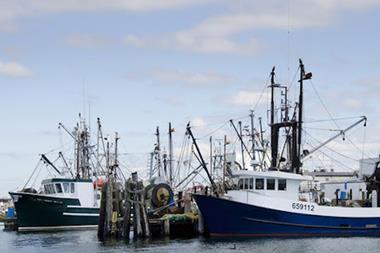
Kaliningrad has changed considerably in the last two decades but it remains a hub for fishing technology.
Apart from the plenary there were two sessions, one devoted to resources and their exploitation and the other to the methods of calculation and design of fishing gear. Some of the presentations would certainly be of interest also to non-Russian fishery industries and science.
For example, OM Lapshin of VNIRO described follow-up studies to AL Fridman's baseline definitions of commercial fishing systems. The main recommendation based on in-depth analysis of fishing surveys and stock assessments, as carried out in Russia, is that the use of mathematical modelling for commercial stocks' assessment is of little effect, without constructing a commercial-ichthyologic model that would comprise data also on distribution and behaviour of the surveyed populations.
AV Nikolaev and M Yu Kuznetsov reported on hydro-acoustic survey of polar cod summer-autumn fishery in the Bering and Chukotsk seas, and on the observed considerable fluctuations in the abundance and extent of the distribution of this, short living species (over 2 million tonnes in 2003 and less than 200,000 tonnes in 2007), a variation ascribed to increased temperature.
Large fishable stocks of the polar cod in the north of the Bering Sea can be expected only in relatively cold years. The authors warn that the quantitative assessment might well be underestimated; because of this fish accumulating also beyond the surveyed area.
According to a paper criticising the low power and capacity of survey trawlers, survey vessels should be among the most powerful, powered with 7,000-8,000 hp, 130m bpp, and equipped with 140-150 x 80-100 m midwater trawlnets to be towed at 5-6 knots, and able to process and carry large catches, simply because only major fishing success may convince commercial skippers to follow the survey vessels' recommendation.
In a timely visit to Fishering, a local gear-maker company, conference participants were told that it recently designed and was marketing allegedly the world’s largest midwater trawl.
Also, a company named KBME Vector of Taganrog reported on a development of an automatic system controlling vessel navigation and manoeuvres and providing the skipper with recommendations and information respective aimed trawling and purse seining.
It is designed for large and medium-scale fishing vessels and is based on integration of several hydro-acoustic and electronic monitors, data recording units and logistic executive units (eg, for collision prevention). It's assumed to contribute to improving fishing efficiency and fuel saving. Another interesting Vector system was a panoramic echosounder.
Another Russian development in the making is the use of sound to attract and guide finfish and squid into fishing gear. The idea is that instead of electric hydro-acoustic instrumentation, the sound mimicking that issued by moving schools of small pelagics is pneumatically generated.
On this evidence, Russian fisheries science and technology is clearly thriving.